
断路器:电箱里那排小开关,凭什么能在 0.02 秒切断短路?Circuit Breakers: How That Row of Small Switches in Your Panel Cuts a Short Circuit in 0.02 Seconds
一个指甲盖大小的塑料盒子,里面藏着两套完全不同的脱扣机构:一套靠热量慢慢弯,一套靠磁场瞬间吸合。短路电流冲到几千安培时,它要在一个周波之内把电路切开。A plastic box the size of a thumbnail hides two completely different tripping mechanisms: one bends slowly with heat, the other snaps shut with a magnetic field. When a short-circuit current surges to thousands of amps, it has to cut the circuit within a single cycle.
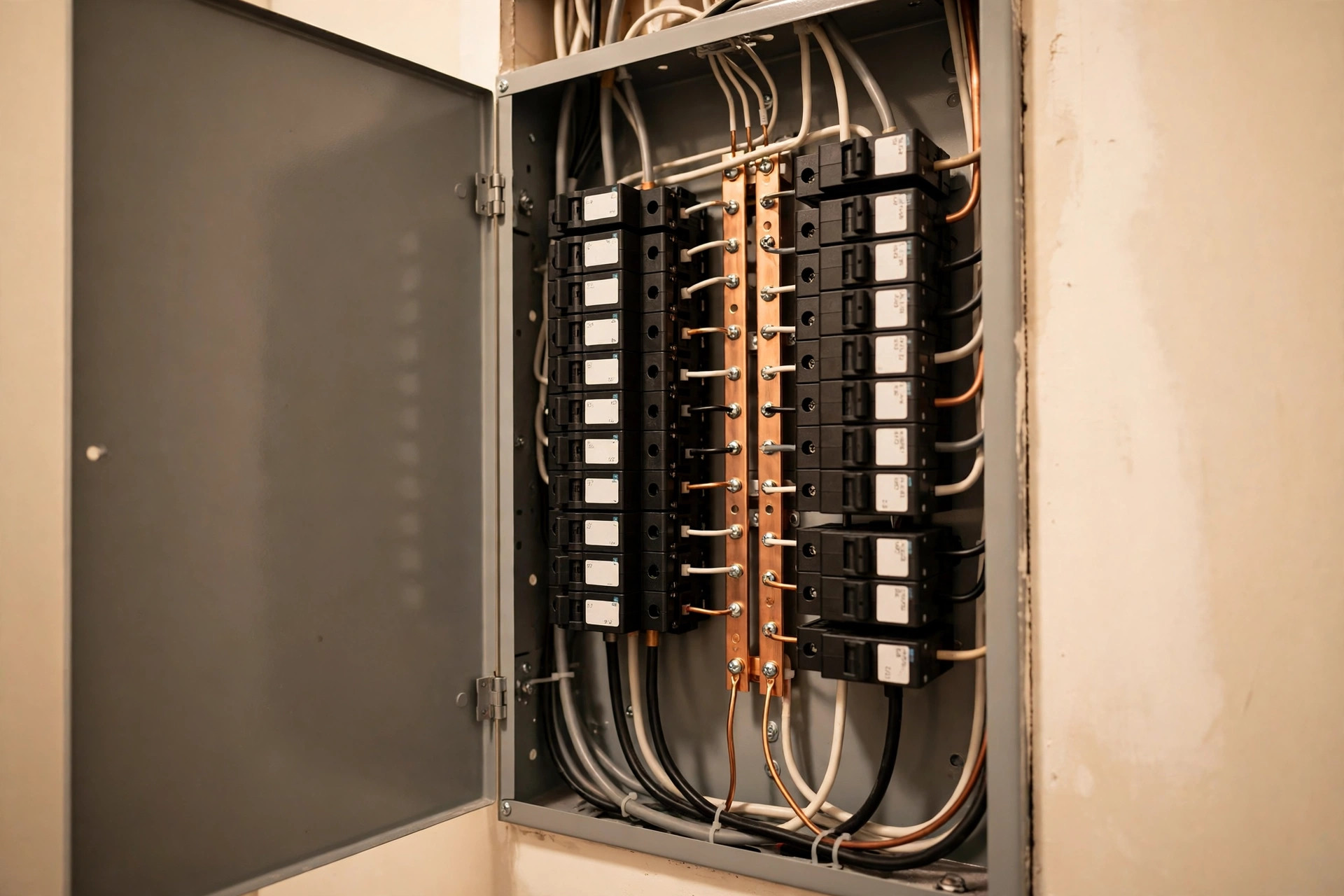
打开家里电箱的门,看到的就是一排排黑色小开关。温哥华、大温地区的独立屋,电箱里通常有二三十只断路器:照明一路、插座一路、厨房一路、暖炉一路、热水器一路、干衣机一路。它们平时一动不动,几十年可能只跳闸一两次,但真到短路那一刻,整个房子的安全就指望它在百分之二秒里动作。Open the door of your home electrical panel and you see rows of small black switches. A detached house in Vancouver or Greater Vancouver typically has twenty or thirty breakers in its panel: one circuit for lighting, one for receptacles, one for the kitchen, one for the furnace, one for the water heater, one for the dryer. They sit still for decades, maybe tripping once or twice in their whole life — but in the moment of a short circuit, the safety of the whole house depends on one of them acting within two hundredths of a second.
先把一个关键概念说清楚:普通断路器保护的是电线,不是人。一只 15 安培的断路器,要等电流超过 15 安培才会跳;人触电时通过身体的电流只有几十毫安,断路器根本感觉不到。所以浴室、厨房这些近水的地方还要另装漏电保护(GFCI,5 毫安就动作),卧室插座回路要装电弧故障保护(AFCI)。断路器、GFCI、AFCI 各管各的,谁也代替不了谁。One key concept first: an ordinary breaker protects the wiring, not people. A 15-amp breaker only trips once current passes 15 amps; the current through a person receiving a shock is only tens of milliamps, which a breaker cannot even feel. That is why bathrooms and kitchens near water need separate ground-fault protection (GFCI, which trips at 5 milliamps), and bedroom receptacle circuits need arc-fault protection (AFCI). Breakers, GFCIs and AFCIs each do their own job — none replaces another.
一、这是什么、在系统里的作用1. What it is, and what it does in the system
断路器是每一条分支回路的守门员。电从 BC Hydro 的电表进来,先到主开关,再分到每一条回路:每一路的火线都经过一只断路器,再去供那一路的灯、插座和电器。电流正常时,断路器就是一段导线;电流超过额定值时,它必须把自己断开,而且要断得够快、够彻底。A breaker is the gatekeeper of each branch circuit. Power comes in from the BC Hydro meter, through the main switch, then splits into branch circuits: the hot wire of every circuit passes through its own breaker before reaching that circuit's lights, receptacles and appliances. While current is normal, the breaker is just a piece of wire. Once current exceeds its rating, it must break itself open — fast, and completely.
- 过载保护:一条回路上同时开太多电器,电流慢慢超过额定值,电线会发热。断路器要在电线绝缘层烤坏之前断开。Overload protection: too many appliances on one circuit push current slowly past the rating, and the wire heats up. The breaker must open before the wire insulation is cooked.
- 短路保护:火线和零线直接碰上,电流瞬间冲到几千安培,电线在零点几秒内就会烧红起火。断路器必须在电线来得及烧起来之前切断。Short-circuit protection: when the hot wire touches the neutral directly, current surges instantly to thousands of amps, and the wire can glow red and catch fire in a fraction of a second. The breaker must cut it before the wire gets the chance.
- 手动隔离开关:师傅检修某一路时,扳下这只断路器就等于把这路的电断了——这是它最日常的用途。Manual isolation: when a technician services a circuit, flipping its breaker down is how that circuit is de-energised — its most everyday use.
额定电流和线径是绑死的:加拿大住宅最常见的 15 安培回路配 14 号铜线,20 安培配 12 号铜线。断路器额定值必须和它身后那根线的载流量匹配——断路器不是越大越好,换一只更大的上去,电线先烧、断路器后跳,保护就失效了。这也是电箱里的活必须由持牌电工来做的原因:选型错了,表面看一切正常,保护已经不存在了。The current rating and the wire size are tied together: the most common residential circuits in Canada are 15-amp circuits on 14-gauge copper wire and 20-amp circuits on 12-gauge copper wire. A breaker's rating must match the current-carrying capacity of the wire behind it — bigger is not better. Fit a larger breaker and the wire burns before the breaker trips, so the protection is gone. That is also why work inside a panel must be done by a licensed electrician: get the sizing wrong and everything looks fine on the surface while the protection no longer exists.
二、品牌型号2. Brands and models
加拿大住宅市场最常见的四个品牌是 Schneider Electric 的 Square D(QO 系列和 Homeline 系列)、Siemens、Eaton(Cutler-Hammer 的 BR 系列和 CH 系列)以及 GE。每个品牌的断路器只能装进自家品牌的电箱——卡扣形状、母排间距、触点位置都是各家自己的尺寸,混装装不上,就算勉强装上也不符合认证。换电箱里的断路器,第一件事就是看电箱盖内侧贴的型号表,上面写明了这只电箱能用什么系列的断路器。The four brands most common in Canadian homes are Schneider Electric's Square D (the QO and Homeline lines), Siemens, Eaton (the Cutler-Hammer BR and CH lines) and GE. Each brand's breaker fits only its own brand of panel — the clip shape, bus spacing and contact position are each manufacturer's own dimensions. A breaker from another brand will not fit, and even if forced in, it would not meet certification. Before replacing a breaker in a panel, the first step is to read the model label inside the panel door, which lists exactly which breaker series that panel accepts.
- 单极 / 双极:单极断路器管 120 伏回路(灯、插座);双极断路器同时切两根火线,管 240 伏回路(干衣机、电炉、暖炉、空调、热水器)。Single-pole / double-pole: single-pole breakers serve 120-volt circuits (lights, receptacles); double-pole breakers cut two hot wires at once and serve 240-volt circuits (dryer, range, furnace, air conditioner, water heater).
- 额定电流:住宅常用 15、20、30、40 安培,数字刻在手柄上。15 安培是照明和普通插座,20 安培是厨房插座,30 安培以上是电炉、干衣机这类大功率设备。Current rating: homes typically use 15, 20, 30 and 40 amps, stamped on the handle. 15 amps is lighting and general receptacles, 20 amps is kitchen receptacles, 30 amps and above is large equipment like ranges and dryers.
- GFCI / AFCI / 双功能:普通断路器只管过电流;GFCI 断路器多一块漏电检测板,5 毫安漏电就跳;AFCI 断路器多一块电弧识别板,能认出电线内部打火的波形;双功能断路器把两者合在一只壳子里。加拿大电气规范要求新建住宅的卧室插座回路装 AFCI,浴室、厨房近水处装 GFCI。GFCI / AFCI / dual-function: an ordinary breaker only handles overcurrent; a GFCI breaker adds a ground-fault sensing board that trips at 5 milliamps of leakage; an AFCI breaker adds an arc-recognition board that can identify the waveform of arcing inside a wire; a dual-function breaker packs both into one case. The Canadian Electrical Code requires AFCI protection on bedroom receptacle circuits in new homes, and GFCI protection near water in bathrooms and kitchens.
- 脱扣曲线 B / C / D:这是断路器的“脾气”:B 型在 3–5 倍额定电流时瞬时跳闸,C 型在 5–10 倍,D 型在 10–20 倍。住宅一般用 B 型或 C 型;D 型是给启动电流很大的电机、变压器用的,家里基本用不上。Trip curves B / C / D: this is the breaker's "temperament": type B trips instantly at 3–5 times rated current, type C at 5–10 times, type D at 10–20 times. Homes generally use type B or C; type D is for motors and transformers with very large starting currents, and is rarely needed in a house.
温哥华很多老房子里还能见到 Federal Pioneer 的 Stab-Lok 电箱,那是上世纪七八十年代装的主流产品。这类电箱的断路器和母排是老式卡扣结构,保险公司看到它常会多问几句;老电箱要不要换,是持牌电工上门检查后才能下的判断,不是看外表新不新能决定的。Many older Vancouver homes still have Federal Pioneer Stab-Lok panels, the mainstream product of the 1970s and 80s. Their breakers and bus bars use an old-style clip construction, and insurers often ask extra questions when they see one. Whether an old panel should be replaced is a judgement only a licensed electrician can make after an on-site inspection — it cannot be decided from how new it looks.
三、内部结构与工作原理:两套脱扣机构,一只灭弧栅3. Internal structure and how it works: two tripping mechanisms and one arc chute
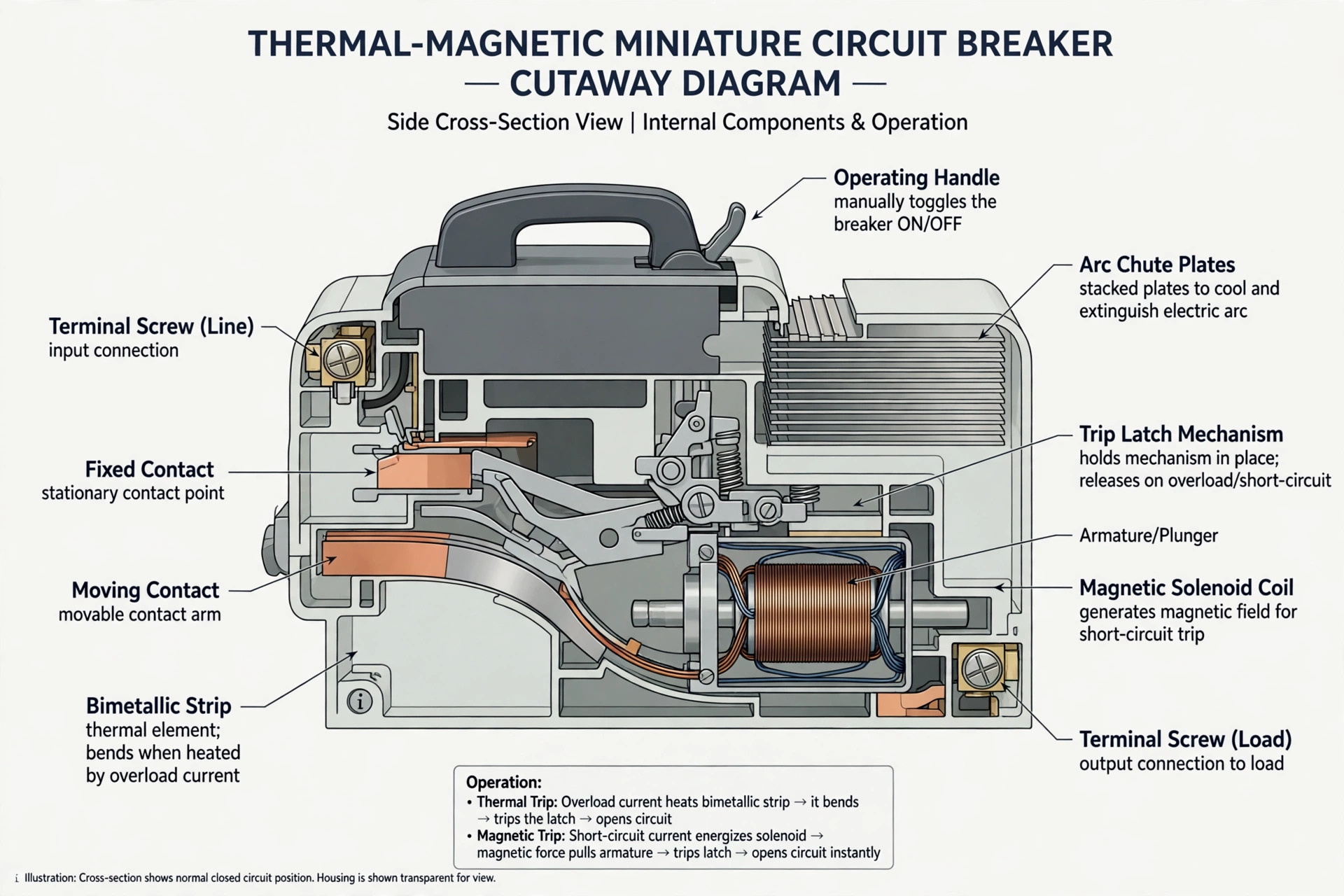
一只普通家用断路器是热磁式的,壳子里同时装着热脱扣和磁脱扣两套机构,分别对付两种性质完全不同的故障。An ordinary household breaker is thermal-magnetic: inside its case sit two tripping mechanisms, thermal and magnetic, each handling a completely different kind of fault.
- 双金属片——管过载:两片热膨胀系数不同的金属(常见的是钢和铜合金)牢牢压合在一起。电流流过时,双金属片自身发热(电流的平方乘以电阻,I²R),温度一高,两边膨胀不一样,整片就向一侧弯曲。过载电流越大,弯得越快,弯到一定程度就顶开脱扣机构,弹簧把触点拉开。这是一个“慢”动作:轻微过载可能要几分钟才跳,2 倍过载几十秒——这正是设计意图:电机启动、暖炉点火那几秒的大电流不该跳闸,只有持续的过载才该断。The bimetallic strip — handles overload: two metals with different thermal expansion coefficients (commonly steel and a copper alloy) are bonded tightly together. As current flows, the strip heats itself (current squared times resistance, I²R); as temperature rises, the two sides expand differently and the whole strip bends to one side. The larger the overload, the faster it bends, until it pushes the trip mechanism open and a spring pulls the contacts apart. This is a "slow" action: a slight overload may take minutes to trip, twice the rated current tens of seconds — and that is by design. The brief surge when a motor starts or a furnace ignites should not trip the breaker; only a sustained overload should.
- 电磁线圈——管短路:线圈绕在铁芯上,电流通过时产生磁场。正常电流的磁场太弱,吸不动铁芯;短路电流一到几千安培,磁场瞬间强到把衔铁(铁芯里的活动铁块)吸合,衔铁直接顶开脱扣机构,触点在 0.02 秒之内分开。磁场不需要等温度上来,所以短路跳闸是“快”动作——60 赫兹交流电一个周波是 1/60 秒,短路保护就是要在一个周波左右完成。The solenoid coil — handles short circuits: a coil wound around an iron core generates a magnetic field when current passes. Normal current makes a field too weak to move the core; but when short-circuit current reaches thousands of amps, the field instantly becomes strong enough to pull in the armature (the moving iron piece inside the core), which pushes the trip mechanism open and separates the contacts within 0.02 seconds. A magnetic field needs no time to heat up, so short-circuit tripping is a "fast" action — one cycle of 60-hertz AC is 1/60 of a second, and short-circuit protection has to complete in about that time.
- 动静触点——电流的必经之路:电流从进线端子进来,经过双金属片和电磁线圈,再从动触点跨到静触点,从出线端子出去。触点平时紧紧压合,靠弹簧保持接触压力;跳闸时动触点被弹簧迅速拉开。触点表面是银合金(常见银氧化锡),银的导电性好、熔点高,氧化锡颗粒让触点在电弧高温下也不容易熔焊在一起。Moving and fixed contacts — the path current must take: current enters through the line terminal, passes the bimetallic strip and the solenoid coil, crosses from the moving contact to the fixed contact, and leaves through the load terminal. The contacts are normally pressed tightly together by a spring; when the breaker trips, the spring pulls the moving contact away fast. The contact surfaces are a silver alloy (commonly silver-tin oxide): silver conducts well and melts at a high temperature, while the tin-oxide particles keep the contacts from welding together in the heat of an arc.
- 灭弧栅片——熄灭电弧:触点在带电流的情况下分开,空气会被击穿,拉出一道几千度的电弧。灭弧栅是一叠平行的钢片,电弧被磁场吹进栅片之间,被切成十几段小电弧,每一段的电压都不够维持电弧,电弧就熄灭了。没有灭弧栅,电弧会一直烧到把塑料壳烧穿。The arc chute — extinguishes the arc: when contacts separate while carrying current, the air breaks down and an arc of several thousand degrees is drawn out. The arc chute is a stack of parallel steel plates; the magnetic field blows the arc into the plates, where it is sliced into a dozen small arcs, each too weak in voltage to sustain itself, and the arc dies. Without the arc chute, the arc would keep burning until it melted through the plastic case.
- 脱扣机构与手柄:脱扣机构是一组精密的杠杆和弹簧,平时被锁扣扣住,靠它把触点保持在闭合状态;双金属片或衔铁一顶,锁扣松开,弹簧瞬间把触点拉开。跳闸后手柄会停在中间位置——这是断路器在告诉你“我是因为故障跳开的,不是我被关掉的”。The trip mechanism and handle: the trip mechanism is a set of precise levers and springs, held locked by a latch that keeps the contacts closed. When the bimetallic strip or the armature pushes it, the latch releases and the spring pulls the contacts apart instantly. After a trip the handle rests in the middle position — the breaker's way of saying "I tripped on a fault, I was not switched off."
上下两端各有一只接线端子:进线端子接电箱母排来的火线,出线端子接去回路的火线;零线不经过断路器,直接回到电箱里的零线排。整个电流回路是串联的:端子 → 双金属片 → 线圈 → 动触点 → 静触点 → 端子,任何一环断开,电路就断了。There is a terminal screw at each end: the line terminal connects to the hot wire from the panel bus, the load terminal to the hot wire going out to the circuit. The neutral wire does not pass through the breaker; it goes straight back to the neutral bar in the panel. The whole current path is in series: terminal → bimetallic strip → coil → moving contact → fixed contact → terminal. Break any link in that chain and the circuit is open.
四、材料、磨损与性能曲线4. Materials, wear and performance curves
断路器最怕的敌人是它自己制造的电弧。每一次带负载分断,触点表面都会被电弧烧掉一点点银合金——这叫电蚀。烧掉的金属变成氧化物粉末落在触点表面,接触电阻慢慢变大,接触点发热又更厉害。触点每烧蚀一次,表面就粗糙一分,直到接触电阻大到平时也会发烫。所以断路器的机械寿命是以万次计的,但带负载分断的次数要少得多;短路跳闸一次,对触点的损伤顶得上几百次正常分合。The breaker's worst enemy is the arc it creates itself. Every time it breaks a loaded circuit, the arc burns a little silver alloy off the contact surfaces — this is called electrical erosion. The burned metal settles as oxide powder on the contacts, contact resistance slowly rises, and the contact point runs hotter. Each erosion roughens the surface a little more, until resistance is high enough that the contact runs hot even in normal use. A breaker's mechanical life is measured in tens of thousands of operations, but the number of loaded interruptions it can survive is far smaller; a single short-circuit trip damages the contacts as much as hundreds of normal operations.
- 触点材料:银合金是主流选择,因为银的导电率在金属里数一数二,熔点 961°C,氧化后导电性也不怎么下降。纯银太软、容易熔焊,所以掺进氧化锡、氧化镍等硬质颗粒做成复合材料。早年用过银氧化镉,镉有毒,现在已经基本淘汰。Contact material: silver alloy is the mainstream choice because silver's conductivity is among the best of all metals, its melting point is 961°C, and it stays conductive even after oxidising. Pure silver is too soft and welds too easily, so hard particles such as tin oxide or nickel oxide are mixed in to make a composite. Silver-cadmium oxide was used in earlier years, but cadmium is toxic and has now been largely phased out.
- 双金属片的老化:双金属片靠两种金属的膨胀差工作,反复受热冷却几十年,两种金属的结合面会疲劳,弯曲特性慢慢漂移。这就是断路器用久了跳闸值会变的原因之一——不是坏了,是材料在原子层面慢慢变了。Bimetallic strip ageing: the strip works on the expansion difference between two metals; after decades of repeated heating and cooling, the bond between the two metals fatigues and the bending characteristic slowly drifts. That is one reason a breaker's trip value changes with age — it is not broken, the material itself has slowly changed at the atomic level.
- 时间-电流曲线:断路器的性能画成曲线才看得明白:横轴是电流(额定值的倍数),纵轴是跳闸时间。1.25 倍电流可能要几分钟,2 倍几十秒,5 倍几秒,10 倍以上不到 0.02 秒。曲线越往右越陡——这就是热脱扣和磁脱扣的分界:左边是双金属片的慢动作,右边是电磁线圈的快动作。The time-current curve: a breaker's performance only makes sense drawn as a curve: current (as a multiple of the rating) on the horizontal axis, trip time on the vertical. At 1.25 times rated current it may take minutes, at twice the rating tens of seconds, at five times a few seconds, and above ten times less than 0.02 seconds. The curve steepens as it goes right — that is the boundary between the two mechanisms: the slow action of the bimetallic strip on the left, the fast action of the solenoid on the right.
- 温度的影响:断路器按 40°C 环境温度标定。电箱装在不通风的壁橱里、夏天箱内温度上到 50°C,同样一只断路器的实际跳闸电流会比标称值低——双金属片还没等电流上来就已经热了。反过来,冬天车库里零下的电箱,断路器会比标称值更“耐扛”。环境温度直接改写了它的性能曲线。The effect of temperature: breakers are calibrated at a 40°C ambient temperature. In a panel inside an unventilated closet, where summer temperatures inside the box can reach 50°C, the same breaker will trip at a lower current than its rating — the bimetallic strip is already hot before the current even rises. Conversely, in a freezing garage in winter, a breaker will tolerate more than its rating. Ambient temperature rewrites its performance curve directly.
断路器的认证标准是 CSA C22.2 No. 5(加拿大)和 UL 489(美国),壳子上印的 CSA 标志就是它通过认证的证明。温哥华、大温地区的房子以木结构为主,木架、木地板、保温棉都是可燃物,电线过热着火没有第二道防线——电箱里那一排小开关,就是整栋房子电路安全的第一道、也是最后一道防线。Breakers are certified to CSA C22.2 No. 5 (Canada) and UL 489 (United States); the CSA mark printed on the case is proof it passed certification. Houses in Vancouver and Greater Vancouver are mostly wood-frame construction — wood framing, wood floors and insulation are all combustible, and there is no second line of defence if a wire overheats and catches fire. That row of small switches in the panel is the first — and the last — line of defence for the whole house's electrical safety.
结尾:一只小开关,管着整栋房子的底线Closing: one small switch guards the whole house's bottom line
断路器不像锅炉、热泵那样天天看得见、摸得着,它一辈子躲在电箱门后面。但它的活最重:双金属片慢慢弯,电磁线圈瞬间吸,灭弧栅片把几千度的电弧切成碎片——三件事加起来,才是一只 15 安培的小开关敢站在几千安培短路电流面前的底气。A breaker is not like a boiler or a heat pump that you see and touch every day; it spends its whole life hidden behind the panel door. But its job is the heaviest: the bimetallic strip bends slowly, the solenoid snaps instantly, the arc chute slices a several-thousand-degree arc into pieces — those three things together are what give a small 15-amp switch the nerve to stand in front of a short-circuit current of thousands of amps.
电箱里的事,判断和动手都交给持牌电工。房主能做的,是知道电箱里有什么、它在保护什么、以及什么时候该打电话。顺带一提,BC 的家里要恒温:最低 20 度,舒适是 24–25 度——恒温不只是舒服,更是保护木结构的房子、水管、风管和消防管;频繁停暖气再猛烧,伤设备、坏得更快。BC 天然气很便宜,一次维修保养的钱就抵一年的燃气费,省那点燃气费不值得拿整栋房子冒险。Judgement and hands-on work inside a panel belong to a licensed electrician. What a homeowner can do is know what is inside the panel, what it protects, and when to make the call. And one more thing: a BC home should be kept at a steady temperature — a minimum of 20 degrees, with 24–25 degrees the comfortable range. Steady heat is not only about comfort; it protects the wood-frame house, the pipes, the ductwork and the fire-protection piping. Stopping the heat and then firing hard damages equipment and wears it out faster. BC natural gas is cheap — one repair or service visit costs as much as a year's gas — so saving a little on gas is not worth risking the whole house.
漏水了?先关水,再打电话Leaking? Shut the Water Off, Then Call
爱家冷暖 24 小时紧急维修,水管漏水是日常活。打电话说清漏水位置和现象,师傅能先判断要不要马上上门,紧急情况优先处理。Ai Jia Nuan offers 24-hour emergency service — pipe leaks are everyday work. Call with the leak location and symptoms; the technician can judge whether an immediate visit is needed, with emergencies prioritised.
微信:PE-2009 · 更多服务见 WeChat: PE-2009 · More services at pe2009.com