
哪种取暖方式最舒适?承包商不会告诉你的秘密Which Heating System Is the Most Comfortable? The Secret Contractors Won't Tell You
恒温器上写着 22 度,脚却还是冷的。舒适不取决于温度计上的数字,取决于房间里的平均辐射温度、头脚温差和空气动不动。这篇从分子讲起,讲透六种取暖方式为什么体感差这么多。The thermostat says 22°C, but your feet are still cold. Comfort is not the number on the thermometer — it is the mean radiant temperature of the room, the temperature difference between your head and your feet, and whether the air is moving. This article starts from the molecule and takes apart why six heating systems feel so different.
结论先说:六种取暖方式里,锅炉地暖最舒适。整面地面低温辐射,头脚温差只有 1.4°C,空气基本不动。一间 26°C 的热风房,体感可能还不如一间 21°C 的地暖房。为什么?往下看。The short answer: of the six heating systems, a boiler-fed radiant floor is the most comfortable. A whole floor radiating gentle heat, only about 1.4°C between head and ankles, and air that barely moves. A 26°C forced-air room can feel worse than a 21°C radiant-floor room. Why? Read on.
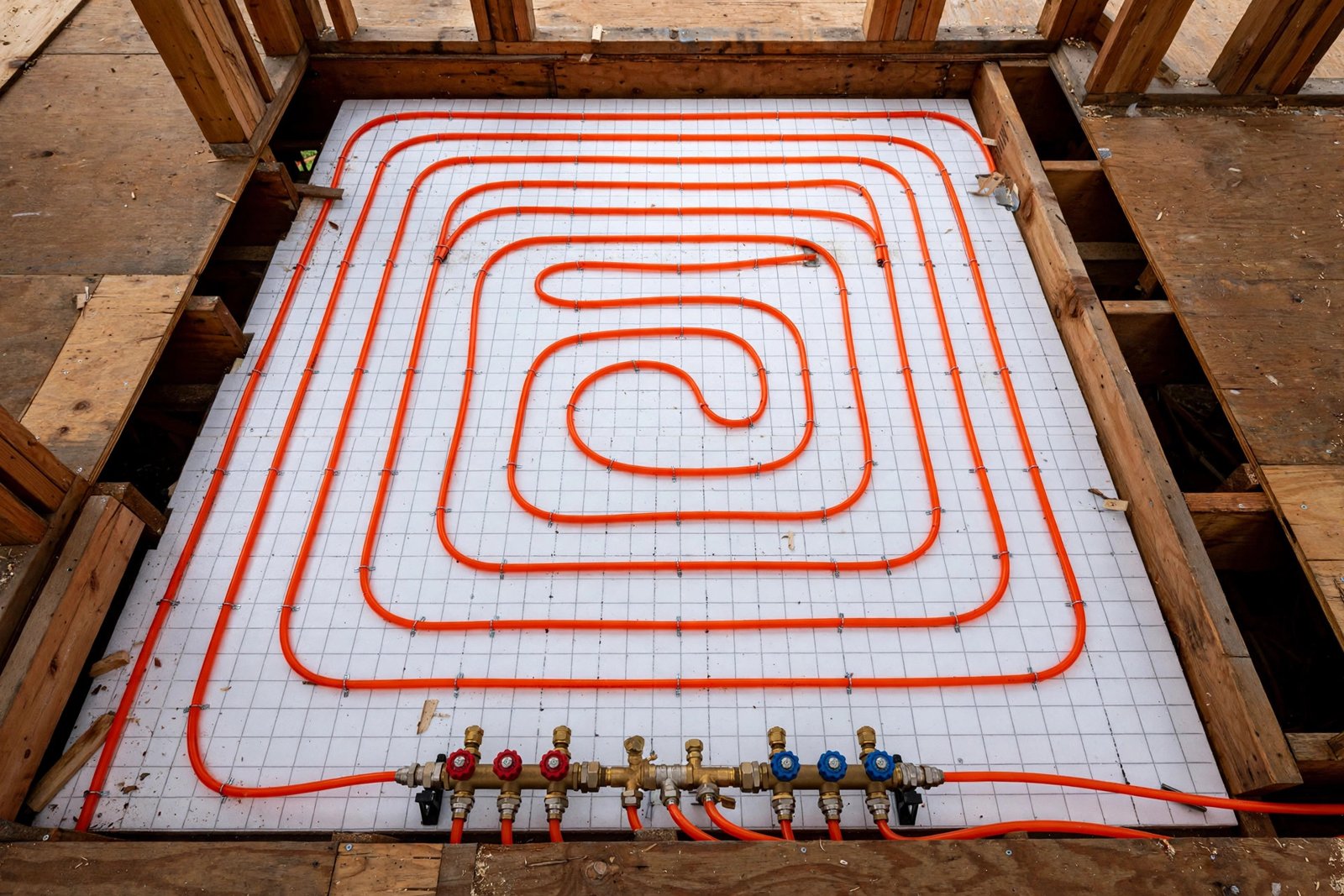
同样是 22°C 的房间,为什么有的房子脚暖头也暖,有的房子脚冷、头顶却闷热?Two Rooms, Both 22°C — Why Is One Warm From Feet to Head, and the Other Cold at the Ankles and Stuffy Overhead?
温哥华、大温地区的房子里,取暖方式不止一种:老房子有暖气片、踢脚线,新房子多是强制热风炉或者热泵,也有不少房子装了锅炉地暖。恒温器都设在 22 度,体感却完全不一样——有的房子光脚踩在地板上是暖的,坐着看书也不觉得有风;有的房子脚踝冷、头顶闷,风口一开就觉得有风吹过脖子。Houses in Vancouver and Greater Vancouver are heated in more than one way: older homes have radiators or baseboards, newer ones mostly have forced-air furnaces or heat pumps, and quite a few have hydronic radiant floors run off a boiler. The thermostats all read 22°C, but the feeling is completely different — in one house the floor is warm under bare feet and there is no draught while you read; in another your ankles are cold, the air overhead is stuffy, and every time the register opens you feel air on the back of your neck.
秘密不在恒温器上。舒适不是空气温度一个数决定的,而是三个东西:房间里各个表面的平均辐射温度、头和脚之间的温差、空气动不动。承包商卖的是一台设备——炉子、热泵、暖气片,装上去就能走;地暖是一套系统工程,要设计、要调试,工期长、造价高,所以很少有人主动推。但物理规律不讲人情:最舒服的热,是从脚下整面地面、慢悠悠发出来的低温辐射。The secret is not on the thermostat. Comfort is not decided by air temperature alone, but by three things: the mean radiant temperature of all the surfaces in the room, the temperature difference between your head and your feet, and whether the air is moving. A contractor sells a piece of equipment — a furnace, a heat pump, a radiator — fitted and gone in a day. A radiant floor is a whole engineered system: it has to be designed and commissioned, it takes longer and costs more, so few people offer it first. But physics does not negotiate: the most comfortable heat is low-temperature radiation rising slowly from the entire floor under your feet.
舒适的物理学:人体是怎么散热的The Physics of Comfort: How the Human Body Loses Heat
人是个恒温动物,安静坐着也要向外散大约 100 瓦的热量,不散出去体温就往上走。散热有四条路:辐射、对流、蒸发、传导。其中辐射是大头——在安静的室内条件下,人体散热的一半以上是靠红外辐射,直接把热量以电磁波的形式发给周围的墙面、地面、家具。热不热,首先取决于你周围那些表面的温度。The human body is a constant-temperature machine: even sitting still it has to shed about 100 watts of heat, or its temperature climbs. Heat leaves by four routes — radiation, convection, evaporation and conduction — and radiation is the biggest one. In a still indoor room, more than half of the body's heat loss is infrared radiation, sent straight out as electromagnetic waves to the walls, floor and furniture around it. Whether you feel warm starts with how warm those surfaces are.
这就引出一个关键概念:平均辐射温度。房间里每个表面的温度不一样,墙冷、窗更冷、地面暖,人体感受到的是它们的加权平均。空气温度和平均辐射温度的平均值,叫体感温度:体感温度 ≈(空气温度 + 平均辐射温度)/ 2。恒温器只测空气温度,测不到平均辐射温度——所以两个空气温度都是 22°C 的房间,一个可以很舒服,另一个脚冷、墙冷,怎么都暖和不起来。That leads to the key concept: mean radiant temperature. Every surface in a room sits at a different temperature — the walls are cool, the windows colder, the floor warm — and what the body feels is their weighted average. The average of air temperature and mean radiant temperature is the operative temperature, the temperature you actually feel: operative temperature ≈ (air temperature + mean radiant temperature) / 2. A thermostat only measures air temperature; it cannot see mean radiant temperature at all. That is why two rooms can both read 22°C while one feels comfortable and the other feels cold at the feet and at the walls, no matter how the thermostat is set.
辐射换热有多强?Stefan-Boltzmann 定律:辐射功率与绝对温度的四次方成正比。一块 25°C 的地面,对着 20°C 的墙面和家具,净辐射换热约 30 W/m²(黑体近似)。整面地面都是 25°C,这个数乘以整个房间的面积,就是源源不断送到人身上和家具上的热量。地面温度每高一度,辐射出去的热量就上一个台阶——所以地暖不需要把地面烧得很烫,24–26°C 就够了。How strong is radiant exchange? The Stefan-Boltzmann law says radiated power grows with the fourth power of absolute temperature. A floor at 25°C facing walls and furniture at 20°C exchanges a net of about 30 W/m² by radiation (black-body approximation). With the whole floor at 25°C, multiply that by the area of the room and you have a steady stream of heat delivered to people and furniture. Every extra degree of floor temperature lifts the radiated heat another step — which is why a radiant floor never needs to be scorching hot: 24–26°C is enough.
传导也不能忽视:脚踩在冷地板上,热量直接从脚底被导走,脚最先觉得冷。脚冷,全身都觉得冷。地暖的地面是暖的,脚底不丢热,这是暖气片和热风永远补不上的。Conduction matters too: stand on a cold floor and heat is conducted straight out of the soles of your feet — the feet feel cold first, and once the feet are cold the whole body feels cold. A radiant floor is warm underfoot, so the feet lose no heat that way — something radiators and forced air can never make up for.
温度是什么:先看分子在干什么What Temperature Is: Look at What the Molecules Are Doing
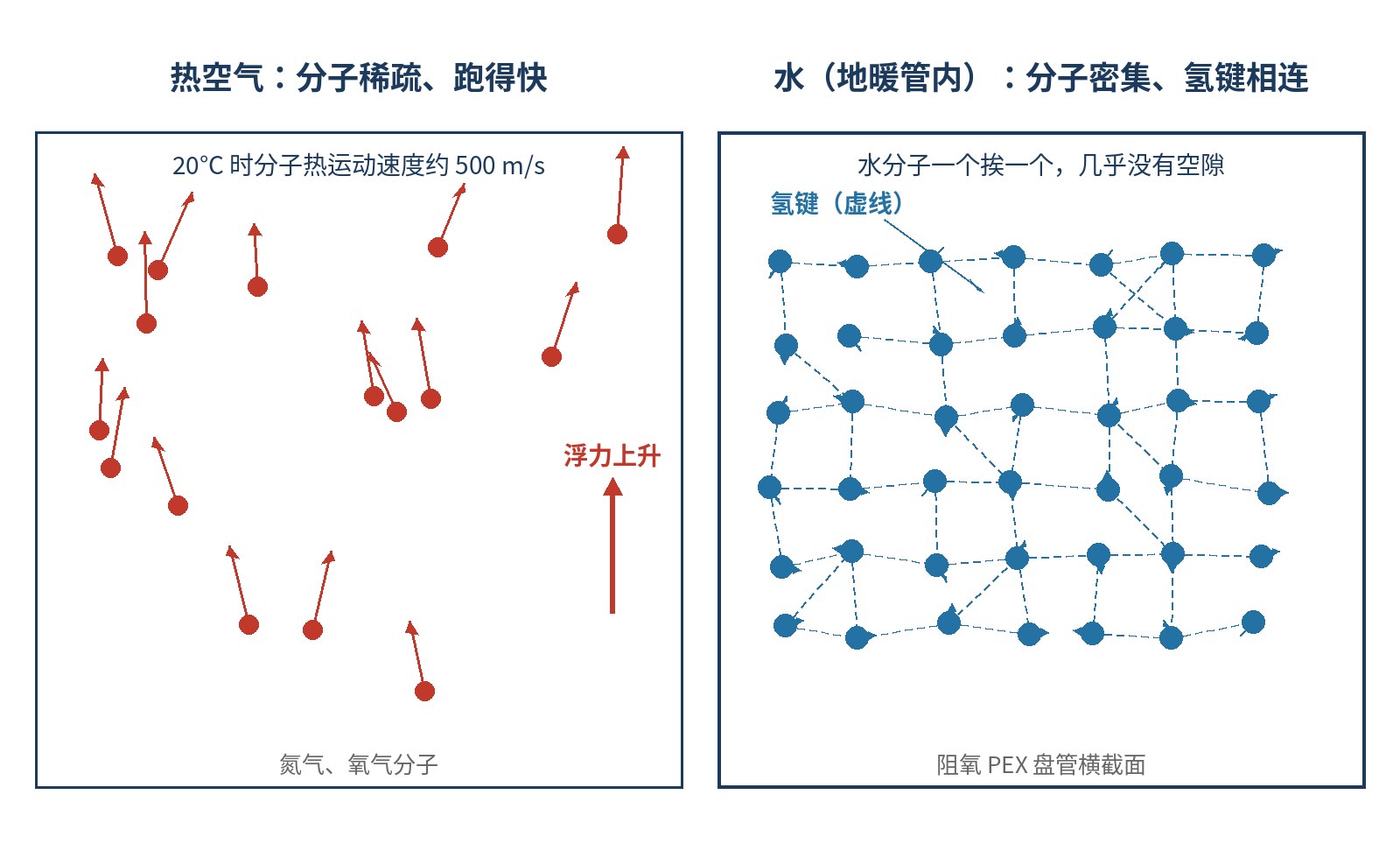
温度就是分子平均动能的量度。空气里的氮气、氧气分子在 20°C 时热运动速度约 500 m/s——比客机巡航还快,只不过它们个头太小、撞来撞去,走不了直线。空气一受热,分子跑得更快、互相离得更远,同样体积的空气变轻了,密度下降,浮力把它往上托。热空气上升、冷空气下沉,这就是对流的起点,也是所有热风取暖分层的根源。Temperature is a measure of the average kinetic energy of molecules. Nitrogen and oxygen molecules in air at 20°C move at about 500 m/s in thermal motion — faster than a cruising airliner, except that they are so small and collide so often that they never travel in a straight line. Heat the air and the molecules move faster and spread further apart; the same volume of air gets lighter, its density falls, and buoyancy lifts it. Hot air rises and cold air sinks — that is where convection begins, and it is the root cause of the stratification in every forced-air heating system.
水是另一回事。水分子之间有氢键拉着,一个挨一个排得密密实实,几乎没有空隙。水的比热容是 4.18 kJ/(kg·K),密度 1000 kg/m³——单位体积的水,载热能力约为空气的 3500 倍。同样是搬运热量,一根细细的水管里的小流量热水,顶得上很大一股热风。地暖就是靠水把热量从锅炉悄悄搬到每一寸地面,再由地面慢慢辐射出来。Water is a different story. Water molecules are held together by hydrogen bonds, packed one against the next with almost no empty space. Water's specific heat is 4.18 kJ/(kg·K) and its density is 1,000 kg/m³ — so per unit volume, water carries about 3,500 times as much heat as air. To move the same amount of heat, a thin pipe carrying a small flow of hot water does the work of a very large stream of hot air. A radiant floor works exactly this way: water quietly carries the heat from the boiler to every square inch of floor, and the floor then radiates it out slowly.
热有三种走法:辐射、对流、传导Heat Travels Three Ways: Radiation, Convection, Conduction
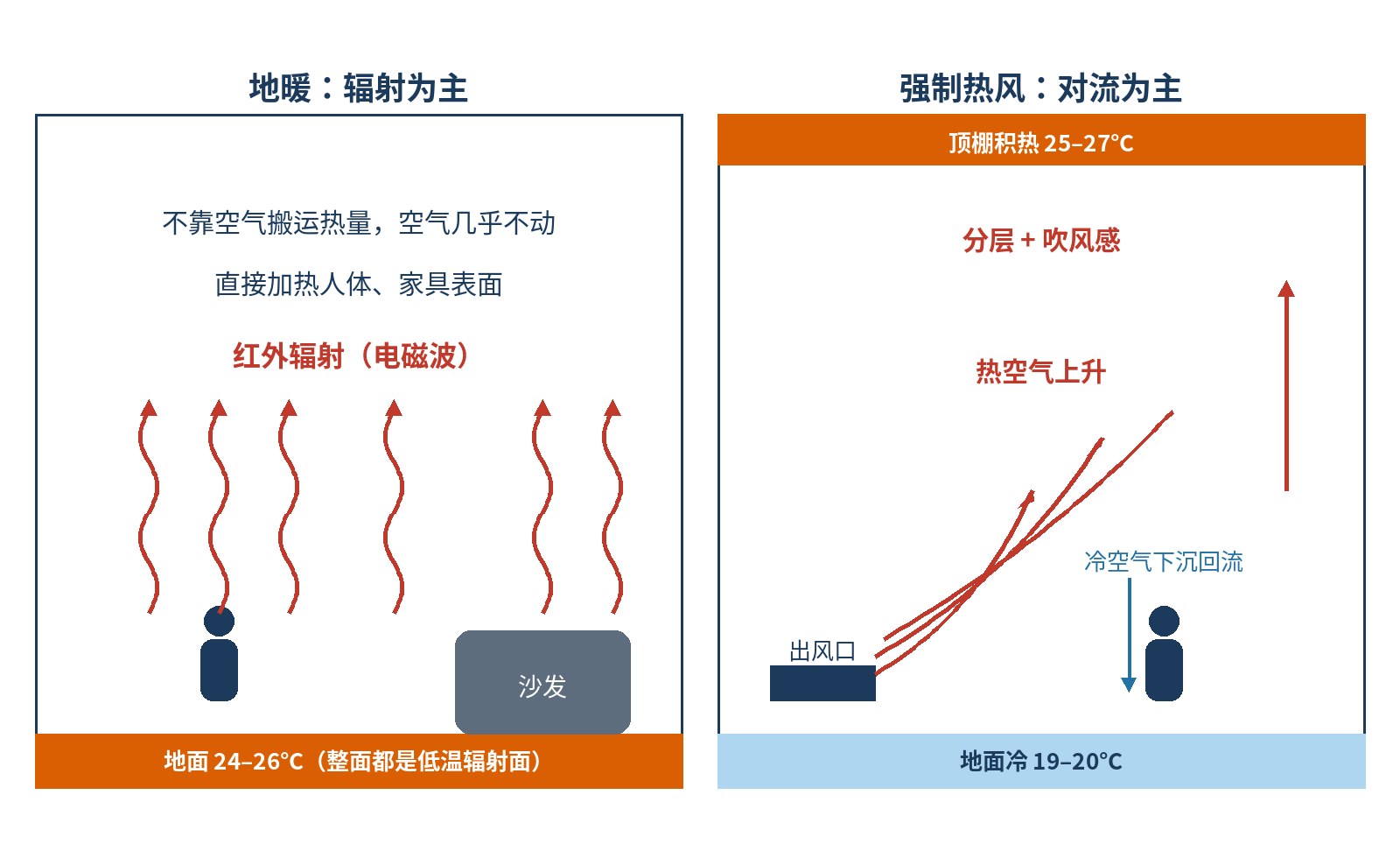
辐射是电磁波,不用介质,穿过空气直接把能量送到表面——太阳晒暖你就是辐射。地暖的地面就是一块巨大的低温辐射板,热量直接到人、到家具,空气几乎不用动。对流是流体自己流动搬运热量——热风炉、暖气片上方的热气流都是对流。传导是分子之间一个撞一个传递能量——脚踩冷地板丢热、铜管把热量传给水,都是传导。Radiation is an electromagnetic wave: it needs no medium and delivers energy straight through the air to a surface — the sun warming your face is radiation. A radiant floor is one enormous low-temperature radiating panel, sending heat directly to people and furniture while the air barely moves. Convection is a fluid moving and carrying heat with it — the warm air from a furnace and the plume rising above a radiator are both convection. Conduction is molecules passing energy along by colliding with each other — feet losing heat to a cold floor, or a copper pipe passing heat to water, are both conduction.
取暖方式的差别,本质上是这三种方式的配比不同。地暖以辐射为主,空气基本静止;强制热风以对流为主,必须让空气动起来,空气一动,吹风感、灰尘、噪音全跟着来;暖气片和踢脚线介于两者之间:既有局部的高温辐射,也有沿着墙面往上爬的对流。The difference between heating systems is, at its root, the mix of these three modes. A radiant floor is mostly radiation, with the air nearly still. Forced air is mostly convection: the air has to move to move the heat, and once the air moves, draught, dust and noise all come with it. Radiators and baseboards sit in between — some local high-temperature radiation, plus a plume of convection climbing the wall.
六种取暖方式的垂直温度梯度The Vertical Temperature Gradient of Six Heating Systems
一间房子的舒适程度,一张图就能看出来:纵轴是高度,从地面到 2.5 米天花板;横轴是空气温度。ASHRAE 55 规定,头部(1.7 米)和脚踝(0.1 米)之间的温差不得超过 3°C——超过这个数,人就会觉得头闷脚冷,怎么调恒温器都没用。How comfortable a room is can be read off a single chart: height on the vertical axis, from the floor to the 2.5-metre ceiling, and air temperature on the horizontal axis. ASHRAE Standard 55 sets the limit: the temperature difference between head height (1.7 m) and ankle height (0.1 m) must not exceed 3°C. Past that number, people feel stuffy-headed and cold-footed, and no thermostat adjustment fixes it.
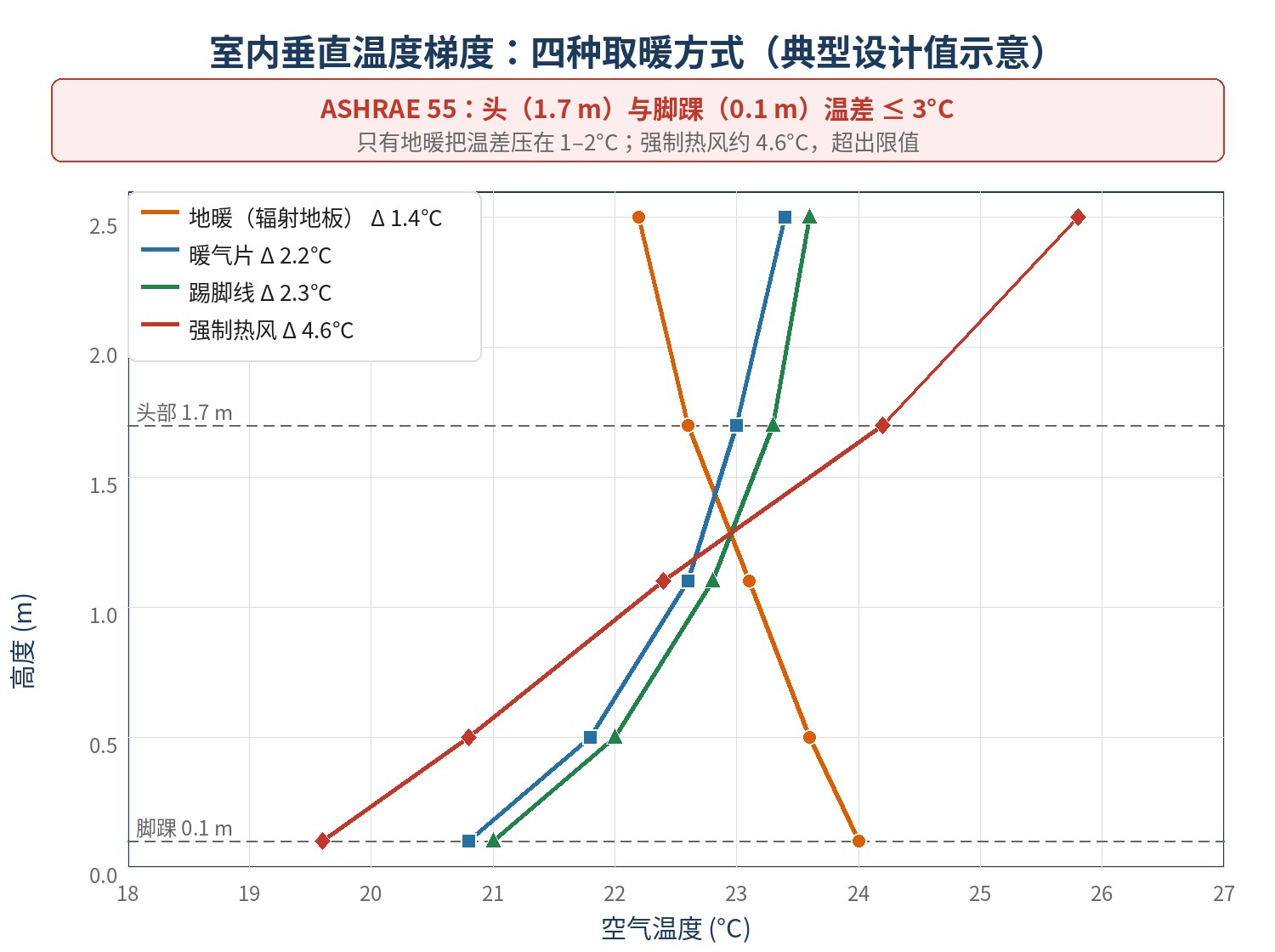
地暖的线最直:地面 24°C,头部 22.6°C,头脚温差只有约 1.4°C。暖气片和踢脚线温差约 2.2–2.3°C,还在限值内,但地面只有 20–21°C,脚底还是偏凉。强制热风的线最斜:地面 19.6°C,头部 24.2°C,温差约 4.6°C,超出 ASHRAE 限值——恒温器装在墙上 1.5 米高,读到的是热空气的温度,脚踝处的冷空气它根本测不到。The radiant-floor line is the straightest: 24°C at the floor, 22.6°C at head height — a head-to-ankle difference of only about 1.4°C. Radiators and baseboards come in at about 2.2–2.3°C, still inside the limit, but the floor sits at only 20–21°C, so the soles of the feet stay cool. The forced-air line is the steepest: 19.6°C at the floor, 24.2°C at head height, a difference of about 4.6°C — past the ASHRAE limit. The thermostat sits on the wall at 1.5 metres, reading the warm air up there; it never sees the cold air at ankle level at all.
地面温度本身也有讲究:ASHRAE 55 规定的地面舒适范围是 19–29°C。地暖地面 24–26°C,正好落在中间;强制热风的地面 19–20°C,贴着下限,脚踩上去就是凉的。Floor temperature has its own standard too: ASHRAE 55 puts the comfortable floor range at 19–29°C. A radiant floor at 24–26°C sits right in the middle of it; a forced-air floor at 19–20°C hugs the bottom edge — cold underfoot.
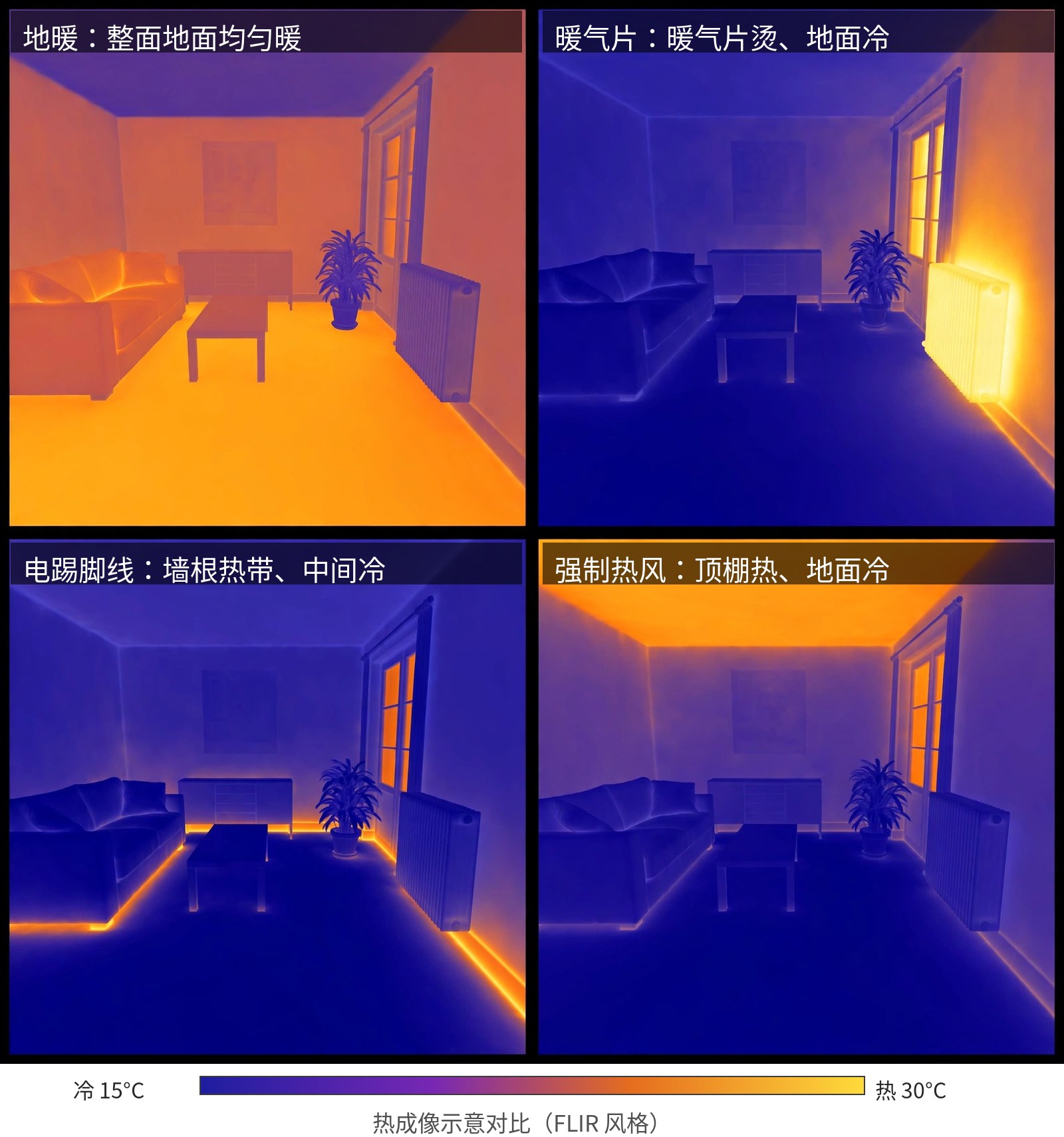
热成像一眼就能看出差别:地暖整面地面是暖的,暖气片只有自己烫,电踢脚线只在墙根有一条热带,强制热风的热量全积在顶棚、地面是冷的。电热丝地暖和水暖地暖一样,都是整面地面辐射,梯度图上和水暖地暖几乎重合,所以梯度图里只画了四条线;六种方式的完整对比在下面那张表里。A thermal camera makes the difference obvious at a glance: with a radiant floor the whole floor is warm; a radiator is hot only by itself; an electric baseboard shows a single hot stripe along the base of the wall; with forced air all the heat is piled up at the ceiling and the floor is cold. An electric radiant floor works the same way as a hydronic one — whole-floor radiation — so its curve nearly overlaps the hydronic curve, which is why the gradient chart plots only four lines; the full six-system comparison is in the table below.
六种取暖方式舒适度对比Comfort Compared: Six Heating Systems
把六种方式放在一张表里,差别一目了然。表中数值为典型设计值,实际数值因房屋保温、层高、系统设计而异。Put all six systems in one table and the differences jump out. Values are typical design figures; actual numbers vary with the house's insulation, ceiling height and system design.
| 取暖方式System | 头脚温差Head–ankle ΔT | 空气流动Air movement | 噪音Noise | 灰尘扬起Dust stirred up | 地面温度Floor temp | 体感均匀性Evenness of comfort |
|---|---|---|---|---|---|---|
| 地暖(水暖)Radiant floor (hydronic) | 约 1.4°C~1.4°C | 几乎不动Nearly still | 无声Silent | 不扬尘None | 24–26°C24–26°C | 最均匀Most even |
| 暖气片Radiator | 约 2.2°C~2.2°C | 轻微对流Slight convection | 无声Silent | 轻微Slight | 地面偏凉Floor on the cool side | 局部温差Local differences |
| 电热丝地暖Electric radiant floor | 约 1.5°C~1.5°C | 几乎不动Nearly still | 无声Silent | 不扬尘None | 24–26°C24–26°C | 最均匀Most even |
| 电踢脚线(240V)Electric baseboard (240V) | 约 2.3°C~2.3°C | 轻微对流Slight convection | 无声Silent | 轻微Slight | 地面偏凉Floor on the cool side | 沿墙热、中间凉Warm at walls, cool in the middle |
| 强制热风炉Forced-air furnace | 约 4.6°C~4.6°C | 明显吹风Noticeable draught | 风机噪音Blower noise | 扬尘明显Obvious | 地面冷 19–20°CCold floor, 19–20°C | 上热下冷Hot above, cold below |
| 热泵(风管 / 分体)Heat pump (ducted / split) | 约 3–4°C~3–4°C | 有吹风感Draught felt | 室外机 + 室内风声Outdoor unit + indoor fan | 扬尘Stirs dust | 地面偏凉Floor on the cool side | 出风口附近温差明显Uneven near the outlet |
为什么地暖最均匀Why a Radiant Floor Is the Most Even
整面地面都是加热面。房间里没有冷表面拖后腿:地面是暖的,墙面和家具被辐射慢慢带暖,平均辐射温度均匀,体感温度在房间每个角落都差不多。暖气片是点热源,热风是风口热源,只有地暖是面热源——面积越大、温度越低,均匀性越好。The entire floor is the heating surface. No cold surface drags the room down: the floor is warm, the walls and furniture are slowly warmed by radiation, the mean radiant temperature is even, and the operative temperature is nearly the same in every corner of the room. A radiator is a point heat source, a register is a vent heat source — only a radiant floor is a surface heat source. The larger the area and the lower the temperature, the more even the comfort.
空气不动。没有风机、没有气流,风速基本为零;ASHRAE 指出,风速超过 0.15–0.2 m/s 人就会觉得有风,地暖根本碰不到这条线。空气不动,灰尘也不扬,家里没有风机声,安静。The air does not move. There is no blower and no air stream, so air speed is essentially zero — and ASHRAE notes that people start to feel a draught once air speed passes 0.15–0.2 m/s, a line a radiant floor never comes near. With the air still, dust stays settled, and with no blower there is no fan noise. The house is quiet.
低温水正好配冷凝锅炉。地暖供水温度一般 35–45°C,回水温度更低,烟气里的水蒸气能在换热器里冷凝下来放热——冷凝锅炉效率最高的工况就是低温回水。高温系统(暖气片供水 70–80°C)回水温度高,烟气冷凝不下来,冷凝锅炉的本事就发挥不出来。Low-temperature water is exactly what a condensing boiler wants. A radiant floor typically runs on 35–45°C supply water, with even cooler return water, so the water vapour in the flue gas can condense in the heat exchanger and give up its heat — the condensing boiler's highest-efficiency operating point is a low return temperature. A high-temperature system (radiators on 70–80°C supply) sends back hot return water, the flue gas never condenses, and the condensing boiler cannot do what it was built to do.
热惰性大,适合恒温。找平层(地面下的蓄热层)吸满了热,升温慢、降温也慢,最适合 BC 家里恒温 24–25°C 长期运行。半夜停掉、早上猛烧,找平层凉透了再烧热要很久,锅炉和系统都受累。BC 家里任何时间最低 20 度,舒适是 24–25 度,恒温就是最好的用法。Its thermal mass is large, which suits steady operation. The screed layer under the floor soaks up heat — slow to warm up, slow to cool down — and that makes it ideal for a BC home held at a steady 24–25°C around the clock. Shut it off overnight and fire it hard in the morning, and the screed has gone cold right through; reheating it takes a long time and strains the boiler and the system. A BC home should never drop below 20°C at any hour, and 24–25°C is the comfortable band — a constant temperature is simply the best way to run it.
为什么热风最不舒服Why Forced Air Feels the Worst
分层是物理规律,不是设备故障。出风口的热空气一出来就往上飘,顶棚先热起来,地面最后才热。恒温器一到设定温度就停机,地面还没暖,风机一停,热空气继续往上跑,脚下更冷。房间上热下冷,恒温器却说已经 22 度了。Stratification is a law of physics, not an equipment fault. Warm air leaves the register and rises immediately; the ceiling warms first and the floor warms last. The thermostat hits its set point and shuts the system down while the floor is still cold — and with the blower off, the warm air keeps drifting upward and the floor gets colder still. The room is hot above and cold below, while the thermostat insists it is already 22°C.
吹风感躲不掉。热量靠空气搬运,风速就不能太小;风一吹过脖子和手臂,皮肤水分蒸发加快,人就觉得凉飕飕的。冬天室外冷空气本身含湿量就低,加热后相对湿度更低,吹着风更觉得干燥。The draught cannot be avoided. When air carries the heat, the air speed cannot be too low — and air moving across the neck and arms speeds up evaporation from the skin, which feels chilly. Winter outdoor air already holds little moisture; heating it drops its relative humidity further, and moving air makes the dryness feel worse.
噪音和灰尘跟着风走。风机、风管的气流声是持续的背景噪音;回风把灰尘一路带回风机,再从出风口送出来,灰尘在全屋循环。过滤网能拦一部分,但空气一直在动,扬尘就停不下来。Noise and dust travel with the air. The blower and the air moving through ducts are a constant background hum; return air carries dust back to the blower, and the supply registers send it out again, so dust circulates through the whole house. A filter catches some of it, but as long as the air keeps moving, the dust keeps moving too.
热泵也是一样的道理。热泵(风管式或分体式)本质上也是对流取暖,只不过出风温度低、运行时间长,分层比燃气炉轻一些;但只要有风,就有吹风感、有上下温差,分体机的出风口附近气流尤其明显。A heat pump follows the same physics. A heat pump — ducted or split — is still convection heating at heart; its supply air is cooler and it runs longer, so the stratification is milder than a gas furnace's. But wherever there is moving air there is draught and a vertical temperature difference, and near a split unit's outlet the air movement is especially noticeable.
为什么暖气片和踢脚线次之Why Radiators and Baseboards Come Second
暖气片表面温度常常超过 60°C,是个局部高温面:靠着它的一边身子被烤得发烫,另一边对着冷墙面,辐射不对称——一边热、一边冷,体感就是不均匀。离暖气片远了,墙面、窗户还是冷的,平均辐射温度上不去。A radiator's surface often runs hotter than 60°C — a local hot spot. The side of your body facing it gets roasted while the other side faces a cold wall: the radiation is asymmetric, hot on one side and cold on the other, and the feeling is uneven. Step away from the radiator and the walls and windows are still cold, so the mean radiant temperature never rises.
暖气片上方有一股往上爬的热气流,带着灰尘往上走,墙面时间长了会在暖气片上方熏出一道灰印子。踢脚线贴着墙面发热,热量顺着墙往上走,房间中间还是凉的,家具一挡,热量更出不来。Above a radiator there is a plume of rising warm air carrying dust with it — leave it long enough and the wall above the radiator picks up a grey streak. A baseboard heats along the wall, and the heat climbs the wall while the middle of the room stays cool; put furniture in front of it and even less heat gets out.
温哥华的老房子,特别是公寓和联排别墅,很多用的就是电踢脚线。标准做法是 240V,每英尺约 250 W,估算按每平方英尺 10 W:一间 12×10 英尺的卧室约 1200 W;一栋 1500 平方英尺的房子,全屋加起来约 15 千瓦。电直接变热,1 度电只出 1 度电的热,没有热泵那种放大效应。In Vancouver's older homes — condominiums and townhouses in particular — electric baseboards are what you will most often find. The standard is 240 V at about 250 W per foot, estimated at 10 W per square foot: a 12 × 10 ft bedroom needs about 1,200 W, and a 1,500 sq ft house adds up to about 15 kW across all its heaters. Electricity turns directly into heat — one kilowatt-hour in, one kilowatt-hour of heat out, with no heat-pump multiplier.
耗电是第一个缺点。全屋同时开,功率就是十几千瓦,按 BC Hydro 2026 年的阶梯电价(第一档 11.87 加分/度,头 675 度/月;第二档 14.08 加分/度),取暖用电很容易冲进第二档,冬天电费账单一下就上去了。The first drawback is the power draw. With the whole house running at once, the load is in the tens of kilowatts, and on BC Hydro's 2026 tiered rate (Step 1: 11.87 cents/kWh for the first 675 kWh a month; Step 2: 14.08 cents/kWh above that), heating use pushes a household into Step 2 quickly, and the winter electricity bill climbs fast.
发热不均是第二个缺点:热量贴着墙面往上走,房间中间还是凉的;线电压温控器是双金属片控温,控温不准、温度波动大,房间一会儿热、一会儿冷。容易失火是第三个缺点,也是最要命的一个:灰尘堆积在发热翅片上,窗帘、家具靠太近会挡住出风,厂家说明书明确要求 heater 上方和前方至少留出 15 厘米空隙——通风口一堵,内部过热就可能起火。温哥华的老公寓里,踢脚线前面堆着箱子、窗帘垂到 heater 上,并不少见。The second drawback is uneven heat: the warmth climbs the wall while the middle of the room stays cool, and the line-voltage thermostat — a bimetallic strip — controls temperature crudely, so the room swings hot and cold. The third drawback is the most serious: fire. Dust collects on the heating fins, and curtains or furniture pushed too close block the airflow; the manufacturer's instructions require at least 15 cm of clear space above and in front of the heater, because a blocked vent can overheat and start a fire. In Vancouver's older condominiums, baseboards with boxes stacked in front of them and curtains hanging down onto them are not uncommon.
但它们比热风强在一点:没有风机,没有全屋循环的灰尘,没有风管噪音。暖气片和踢脚线的问题是局部不均匀,热风的问题是全屋分层加吹风。But they beat forced air in one respect: no blower, no dust circulating through the whole house, no duct noise. Radiators and baseboards suffer from local unevenness; forced air suffers from whole-room stratification plus draught.
地暖系统为什么复杂、为什么贵Why a Radiant Floor System Is Complex — and Costly
地暖不是一台设备,而是一套系统:锅炉、分水器、分区控制、保温层、找平层、盘管间距设计、系统调试,缺一环都不行。温哥华、大温地区的木架房子做地暖,从结构到管路都要按这套系统来设计。A radiant floor is not a piece of equipment — it is a system: boiler, manifold, zone controls, insulation, screed, loop-spacing design and commissioning, and every link has to be right. In the wood-frame houses of Vancouver and Greater Vancouver, a radiant floor has to be designed as a system from the structure down to the pipework.
盘管间距是按房间热负荷算的:靠外墙、窗户的地方热损失大,管排得密;房间中间热损失小,管排得疏。间距密了地面温度均匀,但回路变长、阻力变大;间距疏了阻力小,但地面容易一块热、一块凉。每个回路的长度、流量都要在分水器上调平衡,流量不均,远的回路就热不起来。Loop spacing is calculated from each room's heat loss: tight spacing near exterior walls and windows, where heat loss is greatest, and wider spacing in the middle of the room, where it is smaller. Tight spacing makes the floor temperature even, but the loops get longer and the pressure drop grows; wide spacing keeps the pressure drop down, but the floor can end up patchy — hot in one spot, cool in another. Every loop's length and flow has to be balanced at the manifold; if the flows are uneven, the far loops never get warm.
管材要分清楚:埋在找平层里的盘管是阻氧 PEX 管——这是行业标准,埋地盘管不用铜管;分水器以上的明管走铜管,接头要烧焊,现场动火,木架房子里防火措施不能少。保温层铺在盘管下面,热量只能往上走,不能往下漏;找平层既是蓄热层,也是地面找平,厚度直接影响系统反应快慢。The pipe materials have to be kept straight: the loops buried in the screed are oxygen-barrier PEX — that is the industry standard, and buried loops are not copper. The exposed pipe above the manifold is copper, and its joints are soldered with open flame, so fire precautions are non-negotiable in a wood-frame house. Insulation goes under the loops so the heat can only go up, never down; the screed is both the heat-storage layer and the floor levelling, and its thickness sets how fast or slow the system responds.
调试是最后一道功夫:打压、排气、调平衡、按室外温度设定供水温度,每一步都要做。地暖是按房子定制的系统工程,出方案要先上门看现场、算热负荷——温哥华这边上门报价、出方案是收费的,没有免费报价。系统复杂,造价自然高,但复杂换来的是全屋均匀的体感。Commissioning is the final craft: pressure testing, air purging, flow balancing, and setting the supply temperature against the outdoor temperature — every step has to be done. A radiant floor is a system engineered for one specific house, and producing the design means visiting the site and calculating the heat loss first — in Vancouver, site visits and designs are a paid service, and there is no free quotation. The system is complex, and that complexity is what it costs — but what it buys is even comfort across the whole house.
水暖地暖的施工流程:自流平水泥与几千尺盘管Hydronic Radiant Floor Installation: Self-Levelling Screed and Thousands of Feet of Tubing
地暖的贵,很大一部分贵在施工——但这套工程几乎都是建房的时候就做好的。大温地区的房子,地暖绝大多数就是建房时装的;装修翻新的时候几乎没有人去动它,因为造价太高,差不多等于除了木架、把整个房子重做一遍。顺序不能乱,每一步都要干透、验过才能往下走:自流平水泥找平层加上饰面,地面要抬高几厘米,门、楼梯、橱柜都要跟着改。Much of what a radiant floor costs is the installation — but that work is almost always done when the house is built. In Greater Vancouver, the overwhelming majority of radiant floors go in during construction; almost nobody adds one in a renovation, because the cost is so high it is nearly the same as rebuilding the whole house except for the wood frame. The sequence cannot be shuffled, and every step has to dry and be checked before the next begins: the self-levelling screed plus the finished flooring raises the floor by several centimetres, and the doors, stairs and cabinets all have to be adjusted to match.
第一步,热负荷计算与回路设计。先算每个房间的热损失:Q = U × A × ΔT(围护结构的传热系数 × 面积 × 室内外温差),再定分水器位置、管间距和回路数。靠外墙、窗户的地方热损失大,管排得密(6 英寸间距);房间中间热损失小,管排得疏(9–12 英寸间距)。Step one, heat-loss calculation and loop design. The heat loss of every room is calculated first — Q = U × A × ΔT, the U-value of the building envelope times its area times the indoor-outdoor temperature difference. That sets the manifold position, the tube spacing (6-inch spacing near exterior walls and windows, 9–12 inches in the middle of the room) and the number of loops.
第二步,基层处理与保温。清理基层,铺防潮层,再铺 XPS 保温板(地面保温一般 R-5 起步),热量只能往上走,不能往下漏到楼板或地面里去。Step two, subfloor preparation and insulation. The subfloor is cleaned, a vapour barrier goes down, then XPS insulation board (typically R-5 and up under a heated floor) so the heat can only go up, never down into the slab or the ground below.
第三步,铺盘管。阻氧 PEX 管按蛇形或回形布管,用卡钉或网格板固定,弯头不能死折。管与管之间留出设计间距,分水器到房间的引管也要算进回路长度里。Step three, laying the loops. Oxygen-barrier PEX is laid in serpentine or spiral patterns and fixed with staples or grid panels; bends must not be kinked. The design spacing is kept between runs, and the leader runs back to the manifold count toward each loop's length.
第四步,接分水器、打压测试。所有回路接到分水器,打压到 100 psi、保压 24 小时验漏;浇筑的时候也要保持压力,管子一破立刻能发现——等水泥干了再发现漏水,就只能砸地面了。Step four, manifold connections and pressure test. Every loop is connected to the manifold and the system is pressurised to 100 psi and held for 24 hours to prove there are no leaks; pressure is kept on during the pour, so a punctured tube shows up immediately — find a leak after the cement has set and the only fix is breaking up the floor.
第五步,浇筑自流平水泥。管顶以上约 1.5 英寸的自流平水泥找平层(薄层找平的最低要求),自己流平、不用抹,找平层既是蓄热层,也是地面基层——这就是地暖热惰性大的来源。Step five, pouring the self-levelling screed. About 1.5 inches of self-levelling cement screed goes over the top of the tubes (the minimum cover for a thin levelling pour). It flows flat on its own — no trowelling — and the screed is both the heat-storage layer and the base for the finished floor. That is where the radiant floor's large thermal mass comes from.
第六步,养护与饰面。找平层养护干透后才能铺地面饰面(瓷砖、木地板),地面抬高几厘米,门和踢脚线都要跟着调整。没干透就铺,饰面迟早要出问题。Step six, curing and finished flooring. The screed has to cure and dry fully before the finished floor (tile, wood) goes on, and the raised floor level means doors and baseboards have to be adjusted. Lay the finish over a screed that is still wet and the finish will fail sooner or later.
第七步,注水、排气、调平衡、调试。系统注水排气,每个回路在分水器上调平衡,按室外温度设定供水温度,试运行后才算完工。哪一步没做到位,地面就是一块热、一块凉。Step seven, fill, purge, balance, commission. The system is filled and purged of air, every loop is balanced at the manifold, the supply temperature is set against the outdoor temperature, and the system is test-run before handover. Any step skipped or skimped shows up as a floor that is hot in one spot and cool in another.
算一算,管子要多少:盘管总长 L = 面积 A ÷ 管间距 S。1500 平方英尺的房子,6 英寸(0.5 英尺)间距要 3000 英尺;9 英寸(0.75 英尺)间距要 2000 英尺。2000 平方英尺以上的房子,管子轻松几千尺;上万平方英尺的豪宅,盘管几万尺。How much tubing? Do the maths: total loop length L = floor area A ÷ tube spacing S. A 1,500 sq ft house needs 3,000 ft of tube at 6-inch (0.5 ft) spacing, and 2,000 ft at 9-inch (0.75 ft) spacing. A house over 2,000 sq ft runs to several thousand feet; a mansion over 10,000 sq ft needs tens of thousands of feet.
回路数:N = L ÷ L_max。1/2 英寸阻氧 PEX 管每回路最长约 250–300 英尺(算上分水器引管),超过这个长度,阻力太大、循环泵推不动,末端水都凉了。3000 英尺的管子,按每回路 300 英尺算要 10 个回路;算上引管,实际每回路铺设段约 250 英尺,约 12 个回路;同一分水器上的回路长度要相近(相差 10% 以内),不然短回路抢水、长回路不热。Number of loops: N = L ÷ L_max. A 1/2-inch oxygen-barrier PEX loop tops out at about 250–300 ft, leaders included — past that, the pressure drop gets too big for a residential circulator to push, and the far end of the loop runs cold. 3,000 ft of tube at 300 ft per loop means 10 loops; counting the leaders, each loop's field run is about 250 ft, so closer to 12 loops in practice — and the loops on one manifold have to be close in length (within about 10% of each other), or the short loop steals the flow and the long loop stays cold.
流量与散热量:水侧热量 Q = ṁ × c_p × ΔT,英制常用 Q(BTU/h)= 500 × 流量(gpm)× 供回水温差(°F);供回水温差一般 10–20°F。地面散热量约 25–40 BTU/h·ft²(视地面温度和面层而定)。Flow and heat output: on the water side, Q = ṁ × c_p × ΔT — in imperial units, Q (BTU/h) = 500 × flow (gpm) × supply-return temperature difference (°F). The supply-return difference is typically 10–20°F. Floor heat output runs about 25–40 BTU/h·ft², depending on floor temperature and the floor covering.
一整套流程走下来,铺管、浇筑、养护、调试,工期按周算,中间任何一步返工都要掀地面重来——这就是地暖贵的原因,也是它不能随便找人做的原因。That whole sequence — pipework, pour, curing, commissioning — is measured in weeks, and any step that has to be redone means lifting the floor and starting again. That is why a radiant floor costs what it costs, and why it is not a job for just anyone.
电热丝地暖:施工简单,但不太推荐Electric Radiant Floor: Simpler to Install, but Not Recommended
电热丝地暖是另一种地暖:发热电缆或电热膜直接铺在地面下(薄床、瓷砖下最常见),不用锅炉、不用分水器、不用水、不怕漏水,施工确实比水暖简单得多,改造一个卫生间、厨房,一两天就能铺好。单论舒适度,电热丝地暖和水暖地暖是一样的——都是整面地面辐射,梯度图上几乎重合;差别不在脚感,在电表和故障率上。Electric radiant floor is a different kind of radiant floor: a heating cable or heating mat laid directly under the floor (most often in a thin bed under tile), with no boiler, no manifold, no water and nothing to leak. Installation really is much simpler than hydronic — a bathroom or kitchen can be laid in a day or two. On comfort alone it is identical to a hydronic floor: the same whole-floor radiation, nearly the same curve on the gradient chart. The difference is not under your feet — it is on the electricity meter, and in the failure rate.
耗电是第一个问题。功率密度常见 120–150 W/m²,功率 P = 功率密度 × 面积,日耗电 = P × 运行小时。算一算:100 平方米 × 150 W/m² = 15 kW,一天开 8 小时就是 120 度电,一个月 3600 度。按 BC Hydro 2026 年的阶梯电价(第一档 11.87 加分/度,头 675 度/月;第二档 14.08 加分/度),一个月光这一项电费约 492 加元(只算电量费,不含基本费和税)。水暖地暖烧的是天然气,BC 天然气便宜得多——电直接变热,1 度电只出 1 度电的热,没有热泵的放大,账算下来就是贵。The power draw is the first problem. Power density is typically 120–150 W/m²; power P = power density × area, and daily consumption = P × hours run. Take 100 m² at 150 W/m²: that is 15 kW, and 8 hours a day is 120 kWh a day — 3,600 kWh a month. On BC Hydro's 2026 tiered residential rate (Step 1: 11.87 cents/kWh for the first 675 kWh a month; Step 2: 14.08 cents/kWh above that), that one item alone costs about $492 a month in energy charges (before the basic charge and tax). A hydronic floor burns natural gas, and BC gas is far cheaper — and resistance heat gives back exactly one watt of heat per watt of electricity, with no heat-pump multiplier. The arithmetic is simply expensive.
故障率不低是第二个问题。电缆铺设时容易被划伤、压伤(铺砖、打钉都可能伤到),温控器与地温传感器也容易出故障;更麻烦的是单点故障——一处断了,整个区域都不热;要修就得掀地面、砸瓷砖,维修代价比水暖大得多。所以电热丝地暖一般只用在卫生间、厨房这种小面积、偶尔开的地方,不推荐做全屋取暖。The failure rate is the second problem, and it is not low. Cable gets nicked or crushed during installation — a trowel, a tile, a nail can all damage it — and thermostats and floor sensors fail too. Worse, a single fault kills a whole zone: one break and the entire area goes cold, and fixing it means lifting the floor and breaking tile — a far bigger repair than anything on a hydronic system. So electric floor heating is generally used only in small, occasionally heated areas like a bathroom or kitchen, not as whole-house heating.
结论:承包商不会告诉你的秘密The Bottom Line: The Secret Contractors Won't Tell You
秘密其实就一句话:舒适不是恒温器上的数字,而是平均辐射温度、头脚温差和空气动不动。一间 26°C 的热风房,体感可能不如一间 21°C 的地暖房——温度计读数一样,身体的感受完全不同。The secret is really one sentence: comfort is not the number on the thermostat — it is the mean radiant temperature, the head-to-ankle temperature difference, and whether the air is moving. A 26°C forced-air room can feel worse than a 21°C radiant-floor room. The thermometer reads the same; the body feels something completely different.
承包商卖的是设备:一台炉子、一台热泵,当天装、当天走,简单利落。地暖是一项工程:要设计、要铺管、要找平、要调试,工期长、环节多,所以很少有人主动推。但物理规律不讲人情:最舒服的热,是低温、大面积、从脚下慢慢发出来的辐射。懂了分子运动和辐射传热,就知道为什么地暖排第一——不是广告说的,是物理算出来的。Contractors sell equipment: a furnace, a heat pump, fitted in a day and gone — simple and quick. A radiant floor is a project: design, pipework, screed, commissioning, a long schedule with many steps, so few people offer it first. But physics does not negotiate: the most comfortable heat is low-temperature radiation from a large surface, rising slowly from under your feet. Once you understand molecular motion and radiant heat transfer, you know why the radiant floor comes first — not because an advertisement says so, but because the physics works out that way.
地暖的事,问问师傅Radiant Floor Questions? Ask a Technician
爱家冷暖的师傅每天和锅炉、地暖打交道。说说您家房子和取暖系统的情况,师傅能讲清楚这东西的技术细节,再决定要不要上门。24 小时紧急维修。Ai Jia Nuan's technicians work with boilers and radiant floors every day. Tell us about your house and heating system — the technician can walk you through the technical details and decide whether a visit is needed. 24-hour emergency service.
微信:PE-2009 · 更多服务见 WeChat: PE-2009 · More services at pe2009.com