
烟道:温哥华大温地区锅炉、热水器、地暖、暖气、壁炉的排烟命脉The Flue: The Exhaust Lifeline of Boilers, Water Heaters, Radiant Floors, Radiators and Fireplaces in Vancouver and Greater Vancouver
锅炉烧燃气、地暖升温、暖气片发热、热水器出热水、壁炉点火——烧出来的烟气去哪?答案就是锅炉顶上那根不起眼的白色塑料管:烟道。它不烧水、不发热,却决定了锅炉能不能正常呼吸、烟气里的酸水会不会把设备从里面吃掉。温哥华大温地区 (Vancouver, Surrey, Burnaby, Richmond, UBC, Coquitlam, Delta, Maple Ridge, New Westminster, Langley, North Vancouver, Port Coquitlam, West Vancouver, and Port Moody.) 的房子,冷凝锅炉、地暖、暖气、热水器、壁炉,家家都离不开它。A boiler burning gas, a radiant floor warming up, radiators giving off heat, a water heater making hot water, a fireplace lighting up — where does the exhaust go? The answer is that unassuming white plastic pipe on top of the boiler: the flue. It burns no water and makes no heat, yet it decides whether the boiler can breathe properly, and whether the acidic water in the exhaust eats the equipment from the inside out. In Vancouver and Greater Vancouver, condensing boilers, radiant floors, radiators, water heaters and fireplaces all depend on it.
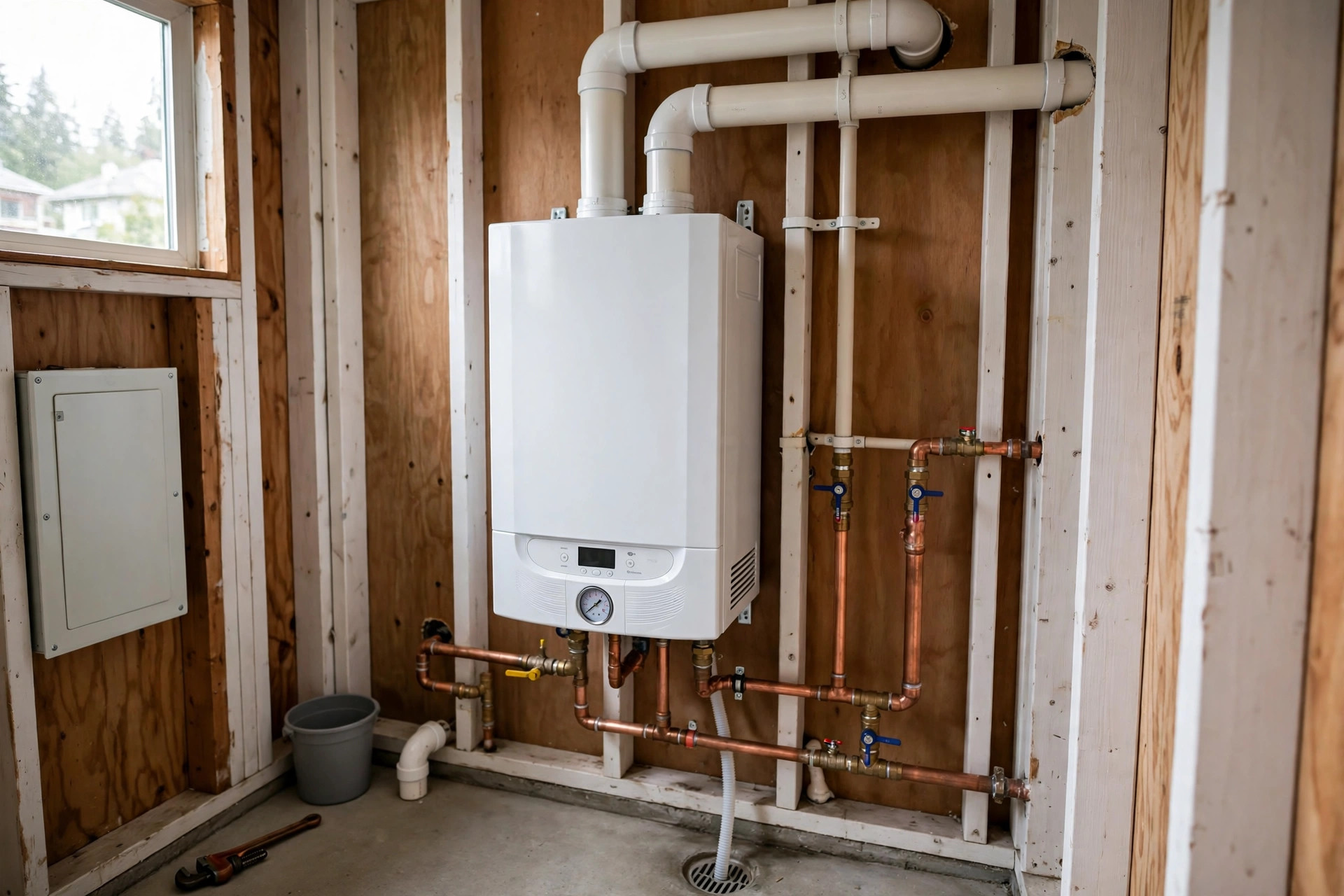
结论先说在前面:烟道不是一根普通的排气管,它是锅炉、地暖、暖气、热水器、壁炉整套燃气系统的“肺”——既要把烧完的废气送出去,又要把燃烧要的新鲜空气引进来,还要把烟气里冷凝出来的酸水接住、中和、排走。烟道选错了材质、走错了坡度、接长了弯头,锅炉、热水器、地暖、暖气整套系统都跟着受罪。这也是暖气工程为什么贵:烟道不是随便接一根管子就完事,算长度、算弯头、配管材、做坡度、留检修口,是实打实的技术活。The conclusion first: a flue is not an ordinary exhaust pipe — it is the "lung" of the whole gas-fired system, boiler, radiant floor, radiators, water heater and fireplace included. It has to carry the spent exhaust out, bring in the fresh air combustion needs, and catch, neutralise and drain away the acidic water that condenses out of the exhaust. Get the material wrong, the slope wrong, or the run too long with too many bends, and the whole system — boiler, water heater, radiant floor and radiators — suffers for it. That is also why heating work is expensive: a flue is not just any pipe stuck on the wall. Calculating the length, counting the bends, choosing the material, setting the slope and leaving access for inspection is real technical work.
一、烟道在系统里是干什么的:排烟、进气、排酸水1. What the Flue Does in the System: Exhaust, Air Intake, and Acidic Condensate
燃气锅炉烧的是天然气,主要成分是甲烷(CH₄)。甲烷在燃烧室里和氧气反应:CH₄ + 2O₂ → CO₂ + 2H₂O——烧出来的烟气,主要是二氧化碳和水蒸气。老式大气式锅炉的烟气很烫,一百七八十度,水蒸气以气态直接从烟囱飘走;现代冷凝锅炉不一样,烟气在换热器里被冷水降到五六十度,水蒸气冷凝成液态水,一台 100,000 BTU 的锅炉满负荷烧一小时,能冷凝出 3–4 升水。这就是烟道要同时干三件事的原因:A gas boiler burns natural gas, which is mostly methane (CH₄). In the combustion chamber, methane reacts with oxygen: CH₄ + 2O₂ → CO₂ + 2H₂O — the exhaust is mostly carbon dioxide and water vapour. In an old atmospheric boiler the exhaust is very hot, around 170–180 °C, and the water vapour simply drifts out of the chimney as gas. A modern condensing boiler is different: the exhaust is cooled by cold water in the heat exchanger down to 50–60 °C, the water vapour condenses into liquid, and a 100,000 BTU boiler at full load can condense 3–4 litres of water per hour. That is why the flue has three jobs at once:
- 排烟:把二氧化碳和残余的一氧化碳、氮氧化物送到室外。冷凝锅炉的烟气温度低、浮力小,靠自身热浮力飘不出去,所以锅炉里有一只风机(blower)强制把烟气推出去——这类叫第四类排烟(Category IV,正压排烟)。风机一停,烟气就推不动了,所以烟道全程必须气密,一处接头漏气,废气就漏进锅炉房。Exhaust: it carries carbon dioxide, plus traces of carbon monoxide and nitrogen oxides, outside. A condensing boiler's exhaust is cool, with little buoyancy, so it cannot rise out on its own heat — a blower fan inside the boiler forces it out. This is Category IV venting, positive-pressure venting. When the fan stops, the exhaust stops moving, so the whole flue run must be airtight — one leaking joint and exhaust gas spills into the boiler room.
- 进气:燃烧要氧气。温哥华大温地区的冷凝锅炉、地暖、暖气系统,绝大多数用的是密闭燃烧(sealed combustion):新鲜空气不从锅炉房里抽,而是从室外经烟道引进来。最常见的做法是同轴烟道——一根管子套着另一根管子:内管走烟气出去,外管走新鲜空气进来,两股气流在同一根管子里反向走,互不干扰。锅炉房的门窗再严实,锅炉也不缺氧。Air intake: combustion needs oxygen. The vast majority of condensing boilers, radiant floors and radiator systems in Vancouver and Greater Vancouver use sealed combustion: fresh air is not drawn from the boiler room, but brought in from outside through the flue. The most common design is the concentric flue — one pipe inside another: exhaust gas goes out through the inner pipe, fresh air comes in through the outer pipe, the two streams moving in opposite directions inside a single pipe without mixing. No matter how tightly sealed the boiler room is, the boiler never starves for air.
- 排酸水:冷凝水不是清水。烟气里的二氧化碳溶进冷凝水里生成碳酸(H₂CO₃),氮氧化物溶进去生成硝酸,pH 值只有 3–4,跟醋差不多酸。所以冷凝锅炉的烟道要带坡度——水平段每米抬高 2–3 厘米,让冷凝水顺着管子流回锅炉底下的冷凝水存水弯(condensate trap),再经过中和盒(limestone 石灰石碎块)把酸中和掉,才能排进下水道。烟道坡度反了,酸水就积在管子里,慢慢把管子从里面泡坏。Acidic condensate: the condensate is not clean water. Carbon dioxide in the exhaust dissolves into it to form carbonic acid (H₂CO₃), nitrogen oxides dissolve to form nitric acid, and the pH sits around 3–4 — about as acidic as vinegar. That is why a condensing boiler's flue must be sloped — the horizontal run rising 2–3 cm per metre — so condensate runs back along the pipe to the condensate trap under the boiler, then through a neutraliser box (limestone chips) that neutralises the acid before it drains away. Slope it the wrong way and acidic water pools in the pipe, slowly eating it from the inside.
- 前后左右接了什么:烟道的上游是锅炉顶上的风机出口和燃烧室,下游是外墙或屋顶上的排烟口;同轴烟道的外管还连着锅炉的进气口。烟道下面,冷凝水存水弯接中和盒,中和盒接下水道。燃气那边,铜管从燃气表过来——温哥华走管只用铜管,铜管接头要烧焊,现场动火,防火措施不能少——先进燃气阀、再进燃烧器。烟气、空气、燃气、冷凝水,四条路在锅炉顶上交汇,烟道是其中管得最宽的一条。What connects around it: upstream of the flue is the boiler's blower outlet and combustion chamber; downstream is the termination on the outside wall or roof. On a concentric flue, the outer pipe also connects to the boiler's air inlet. Below the flue, the condensate trap connects to the neutraliser box, and the neutraliser to the drain. On the gas side, a copper pipe runs from the gas meter — in Vancouver, gas piping is copper only, joints are soldered with open flame on site, and fire precautions are mandatory — first to the gas valve, then to the burner. Exhaust gas, fresh air, gas and condensate: four streams meet at the top of the boiler, and the flue is the one that manages the most of them.
二、品牌型号:三种管材,认准了就知道能用在哪2. Brands and Models: Three Pipe Materials — Know Them and You Know Where Each Belongs
温哥华大温地区的冷凝锅炉、地暖、暖气、热水器、壁炉,烟道管材基本就是三种,牌子认准了,师傅一听就知道耐温上限、接口方式和能配哪家锅炉。For condensing boilers, radiant floors, radiators, water heaters and fireplaces in Vancouver and Greater Vancouver, flue pipe comes down to three materials. Know the brand and a technician immediately knows the temperature limit, the jointing method and which boilers it pairs with.
- PVC / CPVC——IPEX System 636(加拿大):大温地区装机量最大的烟道系统,白色 PVC 管,胶水粘接。System 636 是专门为冷凝锅炉烟道做的认证系统,PVC 的耐温上限是 65°C,CPVC 是 90°C——冷凝锅炉排烟温度一般在 50–60°C,PVC 刚好够用。特点是便宜、管件全、师傅人人会粘,但耐温余量小,锅炉一出高温烟气就超标,所以只能配冷凝锅炉,绝不能接老式大气式锅炉和壁炉。PVC / CPVC — IPEX System 636 (Canada): the highest-volume flue system in Greater Vancouver: white PVC pipe, solvent-welded joints. System 636 is a certified system built specifically for condensing boiler flues. PVC tops out at 65 °C, CPVC at 90 °C — and a condensing boiler's exhaust normally runs 50–60 °C, so PVC just fits. It is cheap, with a full range of fittings, and every installer knows how to weld it — but its temperature margin is thin, and one blast of high-temperature exhaust exceeds it, so it pairs only with condensing boilers, never with old atmospheric boilers or fireplaces.
- 聚丙烯(PP)——Centrotherm InnoFlue、Duravent PolyPro(德国/美国):欧洲冷凝锅炉的主流烟道,Viessmann、Rinnai 的冷凝机型常用。聚丙烯耐温 110°C 以上,耐酸比 PVC 更强,管子是卡扣式密封圈连接,不用胶水,拆装方便。PP 的管壁薄、重量轻,长距离走管、屋顶穿管都省力;缺点是管件贵、国内备件少,师傅备件箱里不常备。Polypropylene (PP) — Centrotherm InnoFlue, Duravent PolyPro (Germany/USA): the mainstream flue for European condensing boilers, common on Viessmann and Rinnai condensing models. Polypropylene handles over 110 °C and resists acid better than PVC; the pipes join with push-fit gasket seals, no glue, so they come apart easily. The walls are thin and light, which makes long runs and roof penetrations easier; the downside is expensive fittings and scarce local spares — not something a technician usually carries in the parts box.
- 不锈钢——Selkirk、Metal-Fab、Z-Flex(北美):老式锅炉、热水器、壁炉的烟道主力,316L 不锈钢内管、镀铝锌外管,卡扣锁缝连接。耐温几百度,什么烟气都扛得住,但价格最贵,而且不锈钢怕氯离子——烟气里的氯化物冷凝在管壁上,316L 也会点蚀。所以不锈钢烟道一般只用在高温烟气场合,冷凝锅炉反而很少用它,杀鸡不用牛刀。Stainless steel — Selkirk, Metal-Fab, Z-Flex (North America): the workhorse flue for older boilers, water heaters and fireplaces: 316L stainless inner pipe, aluminised outer pipe, twist-lock joints. It handles several hundred degrees and any exhaust gas you throw at it — but it costs the most, and stainless steel fears chloride: chlorides in the exhaust condense on the pipe wall and even 316L will pit. So stainless flues are generally reserved for high-temperature exhaust; condensing boilers rarely use them — no need for a sledgehammer to crack a nut.
- 同轴套件(concentric kit):上面三种管材都有对应的同轴套件——内管排烟、外管进气,一根管子穿墙,墙上只留一个洞。温哥华的木架房子外墙要开洞,洞越少越好,同轴烟道一个洞解决排烟和进气两件事,还不用在锅炉房墙上另开进气口,所以大温地区的新装冷凝锅炉、地暖、暖气系统,十有八九用同轴烟道出墙。Concentric kits: all three materials have matching concentric kits — inner pipe for exhaust, outer pipe for intake, one pipe through the wall, one hole in the wall. A Vancouver wood-frame house needs as few wall penetrations as possible, and a concentric flue solves exhaust and intake with a single hole, with no separate air inlet to cut into the boiler room wall — which is why eight or nine out of ten newly installed condensing boilers, radiant floors and radiator systems across Greater Vancouver vent through a concentric flue.
三、内部结构与工作原理:烟气怎么出去,新鲜空气怎么进来3. Internal Structure and How It Works: How Exhaust Gets Out and Fresh Air Gets In
把一根同轴烟道从中间切开,里面其实就是两根管子套在一起:内管走热烟气、外管走冷空气,中间隔着一层空气层。烟气从锅炉顶上的风机出来,进内管,一路被风机推着往外走;新鲜空气从外墙的排烟口被吸进来,沿着外管反向流进锅炉的燃烧室。两股气流在同一根管子里迎面走,中间只隔一层管壁——热烟气顺便把冷空气预热了一点,燃烧效率跟着提高一截,这叫热回收,冷凝锅炉高效率的零头里,有一份是烟道的功劳。Cut a concentric flue in half and there are really just two pipes, one inside the other: hot exhaust in the inner pipe, cold air in the outer pipe, separated by a layer of air. Exhaust leaves the boiler's blower, enters the inner pipe, and is pushed all the way out by the fan; fresh air is drawn in at the wall termination and flows back along the outer pipe into the combustion chamber. The two streams pass each other inside a single pipe, separated by one pipe wall — and the hot exhaust preheats the cold air on the way, lifting combustion efficiency a notch. That is heat recovery, and a share of a condensing boiler's high efficiency belongs to the flue.
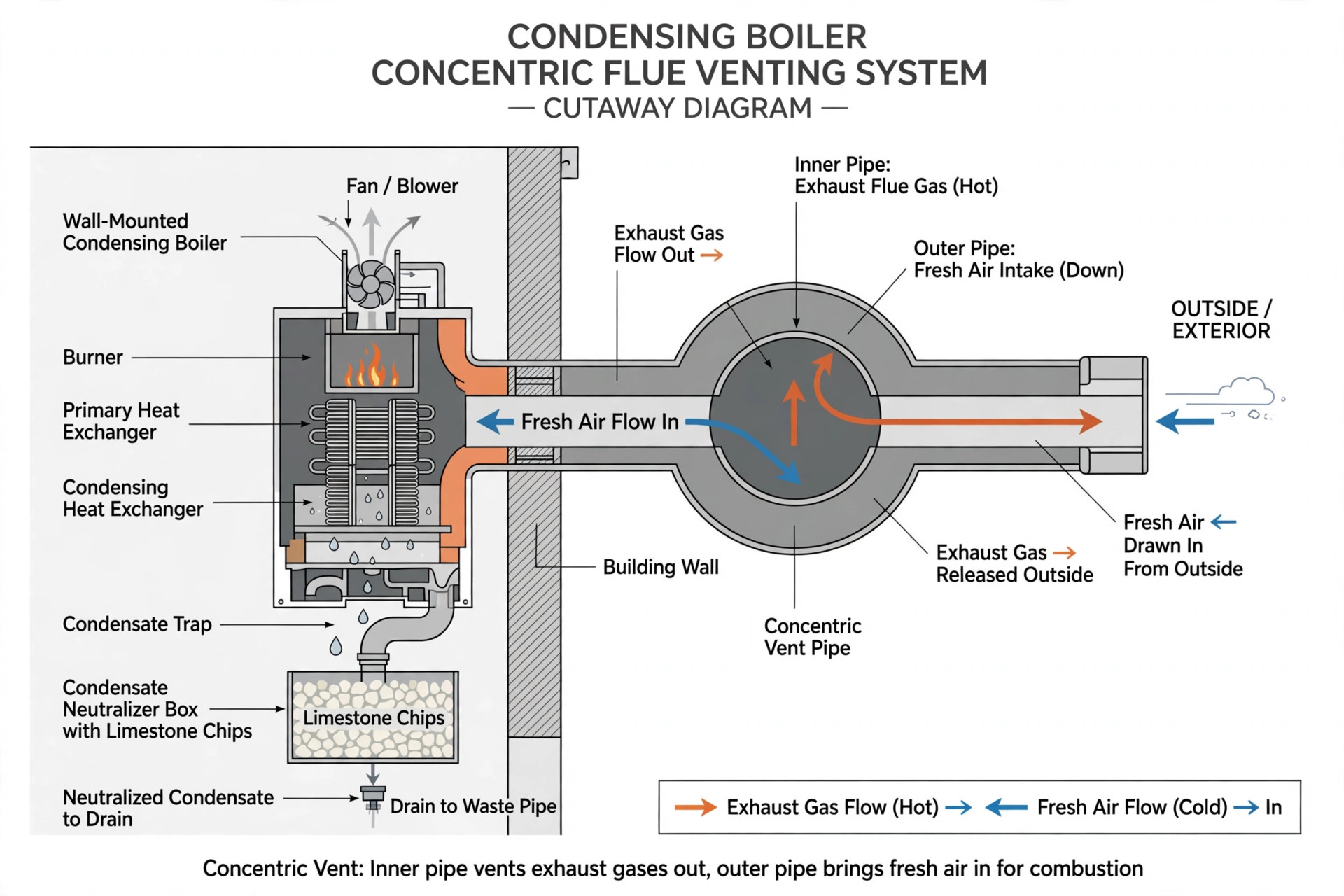
- 烟气为什么会冷凝:水蒸气变成液态水的温度叫露点,天然气烟气的露点大约是 55°C。冷凝锅炉的换热器把烟气冷却到 55°C 以下,水蒸气就一滴一滴凝在换热器和烟道内壁上。冷凝放出的潜热被冷水吸收,这就是冷凝锅炉效率能到 95% 以上的物理原因——老式锅炉把这部分热量直接从烟囱扔掉了。烟气温度越低,冷凝越多,效率越高,但酸水也越多,烟道和中和盒的负担就越重。Why the exhaust condenses: the temperature at which water vapour turns to liquid is the dew point — about 55 °C for natural gas exhaust. A condensing boiler's heat exchanger cools the exhaust below 55 °C, and water vapour condenses, drop by drop, on the heat exchanger and the flue's inner wall. The latent heat released by condensing is picked up by the cold water — that is the physical reason a condensing boiler can exceed 95% efficiency, while an old boiler threw that heat straight up the chimney. The cooler the exhaust, the more condensation, the higher the efficiency — but also the more acidic water the flue and the neutraliser have to handle.
- 风机怎么推烟:冷凝锅炉的风机装在燃烧室前面(预混式),先把燃气和空气按比例混好、吹进燃烧器,再把烧完的烟气一路推出烟道。风机的静压要克服整条烟道的阻力——管子越长、弯头越多,阻力越大。锅炉说明书上写的“最大等效烟道长度”,就是风机推得动的上限:每多一个 90 度弯头,要折算成几米直管扣掉。所以烟道走线要短、要直、弯头要少,绕梁绕柱绕出来的烟道,锅炉烧起来就费劲。How the fan pushes the exhaust: a condensing boiler's fan sits ahead of the combustion chamber (premix design): it blends gas and air in proportion, blows the mixture into the burner, then pushes the spent exhaust all the way out the flue. The fan's static pressure has to overcome the resistance of the entire flue run — the longer the pipe and the more bends, the higher the resistance. The "maximum equivalent vent length" in the boiler manual is the limit of what the fan can push: each extra 90° elbow counts as several metres of straight pipe deducted from the allowance. So a flue run should be short, straight and light on bends — a flue that snakes around beams and columns makes the boiler work hard for every breath.
- 冷凝水存水弯和中和盒:烟道里的冷凝水顺坡流回锅炉,滴进锅炉底下的存水弯——一只 U 形水封,作用和洗手盆下面的存水弯一样:水封住管口,烟气不能从排水管倒灌进锅炉房。存水弯下面接着中和盒,一只装满石灰石(CaCO₃)碎块的小盒子:酸水流过石灰石,碳酸钙和酸反应生成二氧化碳和水,pH 从 3–4 升到接近中性,才能排进下水道。石灰石是消耗品,酸水流过一年,碎块就小一圈,所以中和盒要列入暖气系统的每年保养。The condensate trap and neutraliser: condensate runs back down the sloped flue into the trap under the boiler — a U-shaped water seal that works like the trap under a sink: the water blocks the pipe so exhaust gas cannot flow back into the boiler room through the drain. Below the trap sits the neutraliser, a small box filled with limestone (CaCO₃) chips: acidic water flowing through it reacts with the calcium carbonate to produce carbon dioxide and water, lifting the pH from 3–4 to near neutral before it reaches the drain. The limestone is consumed — a year of acidic water leaves the chips visibly smaller — which is why the neutraliser belongs on the heating system's annual service list.
- 排烟口的位置有讲究:烟道穿出外墙的排烟口,不能离门窗、进气口、邻居家太近,也不能对着人行道——冬天排烟口呼呼冒白汽(那是水蒸气遇冷凝成的小水滴),白汽里带着酸味,熏到邻居的窗户和墙面,时间长了墙面会变色。所以排烟口的位置、高度、离窗户的距离,安装规范里都有明确的数字,师傅选位置,先量距离、再开洞。Where the termination goes matters: the flue terminal through the outside wall must not sit too close to doors, windows, air intakes or the neighbour's house, and must not face a walkway — in winter the terminal puffs white vapour (water vapour condensing into tiny droplets in the cold air), and that vapour carries an acidic tang that discolours a neighbour's window or wall over time. So the terminal's position, height and distance from windows are all set out in the installation code in exact numbers — a technician measures the clearances before cutting the hole.
四、材料、磨损与性能曲线:烟道为什么会老、怎么选才对4. Materials, Wear and Performance Curves: Why Flues Age and How to Choose One Right
烟道泡在酸水和冷热循环里几十年,磨损是从分子层面开始的。第一是 PVC 的热老化:PVC 是聚氯乙烯,长链分子里氯原子是弱点,长期在 60°C 上下、酸水冲刷下,分子链慢慢断裂、增塑剂慢慢跑掉,管子越用越脆、颜色越用越黄——冷凝锅炉排烟温度一失控、冲上 70°C,PVC 管用不了几年就脆得一掰就断。这就是 System 636 只认 PVC 65°C、CPVC 90°C 的原因:耐温上限不是写着玩的,是分子链扛得住的极限。第二是聚丙烯的优势:PP 分子链上没有氯,耐酸、耐温都更好,110°C 也扛得住,但 PP 怕紫外线,露在室外的那一段要包起来,不然太阳晒几年就粉化。A flue spends decades soaked in acidic water and thermal cycling, and the wear starts at the molecular level. First, thermal ageing of PVC: PVC is polyvinyl chloride, and the chlorine atoms in its long polymer chains are the weak point. Held around 60 °C for years under acidic wash, the chains slowly break and the plasticiser slowly leaches out, and the pipe grows more brittle and more yellow with age — let a condensing boiler's exhaust run away to 70 °C and a PVC pipe turns brittle enough to snap in a few years. That is why System 636 rates PVC at 65 °C and CPVC at 90 °C: the temperature limit is not a suggestion, it is the limit the polymer chains can take. Second, polypropylene's advantage: PP chains carry no chlorine, so they resist acid and heat better, holding up past 110 °C — but PP fears ultraviolet light, so the exposed outdoor section must be covered, or a few years of sun will chalk it.
第三是不锈钢的点蚀:316L 不锈钢靠表面一层致密的氧化铬膜防锈,烟气里的氯离子会穿透这层膜,在膜上打出针尖大的蚀孔——孔里是缺氧的酸性环境,铁原子不断失去电子变成铁离子(Fe → Fe²⁺ + 2e⁻),蚀孔越打越深。温哥华、大温地区的水质偏软、氯离子浓度不高,点蚀比硬水区慢,但烟气冷凝水里的氯离子是绕不过去的:不锈钢烟道用在冷凝锅炉上,点蚀的风险比用在高温锅炉上更大,因为高温烟气不冷凝、氯离子不沾管壁。第四是密封圈老化:PP 和不锈钢烟道靠橡胶密封圈气密,密封圈是 EPDM 橡胶,长期在酸水和温度循环里会变硬、失去弹性,密封面压不实,烟气就从接头处微漏——正压排烟最怕这个,漏一点废气进锅炉房,房里的一氧化碳报警器就会响。Third, pitting of stainless steel: 316L stainless steel protects itself with a dense chromium-oxide film, and chloride ions in the exhaust punch pinholes through that film — inside each pit is an oxygen-starved, acidic environment where iron atoms keep losing electrons to become iron ions (Fe → Fe²⁺ + 2e⁻), and the pit drills deeper. Water in Vancouver and Greater Vancouver is fairly soft with low chloride, so pitting is slower than in hard-water regions — but the chloride in flue condensate cannot be avoided: a stainless flue on a condensing boiler actually faces more pitting risk than on a high-temperature boiler, because hot exhaust does not condense and chlorides never wet the pipe wall. Fourth, gasket ageing: PP and stainless flues seal with rubber gaskets, EPDM rubber, which hardens and loses elasticity after years of acidic water and temperature cycling, so the sealing face stops seating properly and exhaust gas weeps out at the joints. Positive-pressure venting fears exactly this: a small exhaust leak into the boiler room, and the carbon monoxide alarm in the house goes off.
选型看三条曲线,而不是只看管径大小。第一是等效长度–风机静压曲线:同样 2 寸管,不同长度、不同弯头数,风机要克服的阻力差几倍,超出锅炉说明书的最大等效长度,风机推不动,锅炉就报风压故障;第二是排烟温度–冷凝量曲线:回水温度越低,烟气冷凝越多,效率越高,但酸水也越多,中和盒消耗越快;第三是坡度–排水曲线:水平段坡度不够,冷凝水流不回存水弯,积在管子里,冬天一冻就把管子胀裂——温哥华冬天虽然不算太冷,锅炉房外墙边的烟道段照样会结冰。所以烟道选型,先看锅炉的功率和排烟温度,再看管材耐温够不够、等效长度够不够短,最后看坡度和中和盒配不配。烟道选对了,锅炉、热水器、地暖、暖气、壁炉整套系统才呼吸得顺;烟道选错了,再好的锅炉也烧不出应有的效率。Sizing follows three curves, not just pipe diameter. First, the equivalent-length-versus-fan-static-pressure curve: the same 2" pipe, at different lengths and bend counts, presents several times more resistance for the fan to overcome — exceed the maximum equivalent length in the boiler manual and the fan cannot push the exhaust through. Second, the exhaust-temperature-versus-condensate curve: the lower the return-water temperature, the more the exhaust condenses, the higher the efficiency — but also the more acidic water, and the faster the neutraliser is consumed. Third, the slope-versus-drainage curve: too little slope on the horizontal run and condensate never makes it back to the trap — it pools in the pipe, and one winter freeze splits the pipe open. Vancouver winters are not brutally cold, but the flue section by the boiler room's outside wall can still freeze. So sizing a flue starts with the boiler's output and exhaust temperature, then checks the material's temperature rating, whether the equivalent length is short enough, and finally whether the slope and neutraliser match. Get the flue right and the whole system — boiler, water heater, radiant floor, radiators and fireplace — breathes easily. Get it wrong and even the best boiler cannot deliver the efficiency it should.
最后说一句中心思想:BC 家里冬天要恒温,最低 20 度,舒适是 24–25 度。地暖和暖气片最怕频繁停机再猛烧——停八小时、再猛烧八小时,锅炉和热水器都伤得更快,木架房子、水管、风管、消防管也跟着受罪。BC 天然气很便宜,一次维修保养的钱就抵一年的燃气费,恒温住着,才是对房子最好的保护。烟道也是一样:它一年 365 天在排烟、进气、排酸水,锅炉恒温运行、烟气温度稳定,烟道里的冷凝水才稳定、酸才可控——恒温,保护的不只是房子和锅炉,还有这根不起眼的白色管子。One last point, and it is the point that runs through everything on this site: a BC home stays at a constant temperature in winter — 20 °C at the minimum, 24–25 °C for comfort. Radiant floors and radiators hate being shut off and then fired hard — eight hours off and eight hours of full burn wears the boiler and water heater faster, and the wood-frame house, its pipes, ducts and sprinkler lines suffer with it. BC natural gas is cheap; one service visit costs about a year's worth of gas. Keeping the house at a steady temperature is the best protection a house can get. The flue is no different: it vents exhaust, draws in air and drains acidic water 365 days a year, and with the boiler running at a steady temperature, the exhaust temperature stays stable, the condensate stays predictable and the acid stays manageable — a steady temperature protects not just the house and the boiler, but this unassuming white pipe too.
漏水了?先关水,再打电话Leaking? Shut the Water Off, Then Call
爱家冷暖 24 小时紧急维修,水管漏水是日常活。打电话说清漏水位置和现象,师傅能先判断要不要马上上门,紧急情况优先处理。Ai Jia Nuan offers 24-hour emergency service — pipe leaks are everyday work. Call with the leak location and symptoms; the technician can judge whether an immediate visit is needed, with emergencies prioritised.
微信:PE-2009 · 更多服务见 WeChat: PE-2009 · More services at pe2009.com