
温哥华大温地区地暖暖气系统里的膨胀水箱:锅炉与热水器水压的缓冲器The Expansion Tank in Vancouver & Greater Vancouver Radiant and Heating Systems: The Pressure Buffer for Your Boiler and Water Heater
一栋温哥华大温地区(Vancouver, Surrey, Burnaby, Richmond, UBC, Coquitlam, Delta, Maple Ridge, New Westminster, Langley, North Vancouver, Port Coquitlam, West Vancouver, and Port Moody.)的房子,地暖盘管里可能装着几十甚至上百升水——水一烧热就要胀大,可铜管和锅炉是硬的、胀不动,多出来的体积去哪?答案就是锅炉旁边那个不起眼的红色钢罐:膨胀水箱。A house in Vancouver and Greater Vancouver can hold tens or even over a hundred litres of water in its radiant floor loops — and hot water expands, while copper pipe and a boiler are rigid and cannot. Where does the extra volume go? The answer is that unassuming red steel tank beside the boiler: the expansion tank.
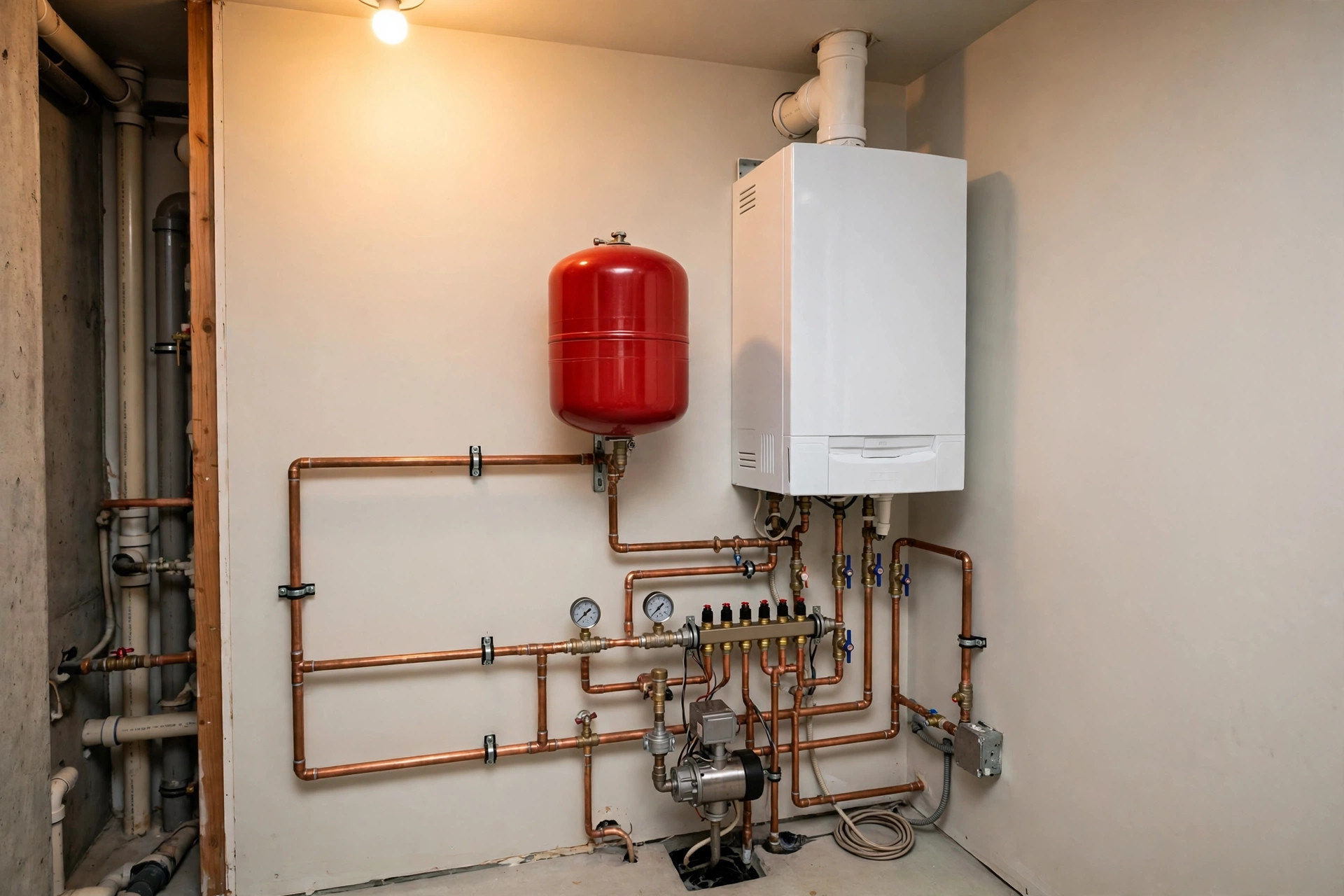
结论先说在前面:膨胀水箱不是一个储水罐,它是整个地暖、暖气、锅炉、热水器系统的水压缓冲器——水热胀冷缩多出来的体积,全靠它里面那团被压缩的空气吞掉;没有它,系统一烧热压力就顶到安全阀泄压,锅炉和热水器天天在高压和泄压之间来回折腾。温哥华、大温地区的木架房子做水暖地暖和暖气片,系统里的水量大、温差大,膨胀水箱选小了、预充气压不对,整个暖气系统的寿命都要打折。The conclusion first: an expansion tank is not a storage tank — it is the pressure buffer for the whole radiant floor, radiator, boiler and water heater system. The extra volume from water expanding and contracting when heated and cooled is absorbed entirely by the pocket of compressed air inside it. Without it, every time the system heats up the pressure would climb until the relief valve dumps water, and the boiler and water heater would be worked back and forth between high pressure and relief, day after day. In the wood-frame houses of Vancouver and Greater Vancouver, a hydronic radiant floor or radiator system holds a large volume of water across a wide temperature range — size the tank too small or set its precharge wrong, and the whole heating system's service life suffers.
一、膨胀水箱是什么,在地暖、暖气、锅炉、热水器系统里干什么1. What an expansion tank is, and what it does in a radiant floor, radiator, boiler and water heater system
先从一个物理事实说起:水烧热了体积会变大。10°C 的冷水烧到 80°C,体积大约膨胀 3%——一栋温哥华大温地区的房子,地暖盘管加锅炉、暖气片里的水,系统总水量常常在 100 升上下,3% 就是 3 升水。3 升水听起来不多,可水是几乎不可压缩的,铜管、锅炉换热器、地暖分水器也都是硬的——多出来的 3 升水没有地方去,系统压力会直线往上顶,直到安全阀被顶开泄水泄压。Start with one physical fact: hot water takes up more space. Water heated from 10 °C to 80 °C expands by about 3% in volume — and a Vancouver or Greater Vancouver house with radiant loops, a boiler and radiators commonly holds around 100 litres of system water, so 3% is 3 litres. Three litres does not sound like much, but water is nearly incompressible, and copper pipe, boiler heat exchangers and radiant manifolds are all rigid — with nowhere for those 3 litres to go, system pressure climbs straight up until the relief valve is forced open to dump water and pressure.
- 接在锅炉旁边:膨胀水箱一般装在锅炉或热水器附近的供水管或回水管上,离循环泵的吸入口越近越好——那里是系统里压力最稳定的点,罐子吞吐水量时对泵的扬程干扰最小。Mounted beside the boiler: the tank is usually fitted on the supply or return pipe near the boiler or water heater, as close as possible to the circulator's suction side — the most pressure-stable point in the system, where the tank's taking in and giving back water disturbs the pump's head the least.
- 水热了它收水:锅炉一烧,水温上升、水体积胀大,多出来的水被压进膨胀水箱,罐子里的空气被压缩,系统压力只缓慢上升,不会顶到安全阀。It takes water in when the water heats: as the boiler fires and the water warms and expands, the extra water is pushed into the tank, the air inside is compressed, and system pressure rises only slowly — never reaching the relief valve.
- 水凉了它还水:锅炉一停,水温下降、水体积收缩,罐子里被压缩的空气反过来把水顶回系统,压力不会掉到零,系统里不会进空气、不会出现气堵。It gives water back when the water cools: when the boiler stops and the water cools and contracts, the compressed air pushes the water back into the system, so pressure never falls to zero and no air is drawn in, no air locks form.
- 热水器那边也有:带储水箱的热水器和封闭式热水系统,冷水一加热同样膨胀,热水器冷水进口处常常也要装一个小一号的膨胀水箱(一般是白色或蓝色罐体,和暖气系统用的红色罐分开),道理完全一样。Water heaters have one too: a storage water heater and any closed domestic hot-water system expand the same way when the cold water heats up, so a smaller expansion tank — usually a white or blue tank, distinct from the red heating-system tank — is often fitted on the water heater's cold inlet, for exactly the same reason.
所以膨胀水箱前面接的是锅炉和热水器、循环泵和分水器,后面接的是几千尺地暖盘管和每一组暖气片;上面是被压缩的空气,下面是系统里的热水。它是整个暖气系统里唯一一个“会呼吸”的部件:锅炉烧多热、地暖盘管有多长、热水器水箱有多大,最后都反映在它吞吐的那几升水上。So the expansion tank connects on one side to the boiler and water heater, the circulator and the manifold, and on the other side to thousands of feet of radiant tubing and every radiator in the house; compressed air above, system hot water below. It is the only component in the whole heating system that "breathes": how hot the boiler fires, how long the radiant loops run, how big the water heater's tank is — all of it ends up in the few litres of water this tank takes in and gives back.
二、品牌型号:隔膜式还是气囊式,红色罐和白色罐有什么区别2. Brands and models: diaphragm or bladder, and what is the difference between the red tank and the white tank
大温地区暖气工程里最常见的膨胀水箱品牌,是北美和欧洲做暖通的老牌子:Amtrol(Extrol 系列,北美市场占有率最高)、Watts、Zilmet、Caleffi、Flamco、Reflex、A.O. Smith(配自家热水器)。温哥华的华人师傅最常装的是 Amtrol Extrol 和 Watts 的红色罐,配自家的锅炉和地暖分水器;欧洲品牌 Zilmet 和 Flamco 在新房项目里也很多。The expansion tank brands most often seen in heating jobs across Greater Vancouver are the established North American and European hydronics names: Amtrol (the Extrol line, the largest share of the North American market), Watts, Zilmet, Caleffi, Flamco, Reflex and A.O. Smith (matched to its own water heaters). Chinese-Canadian installers in Vancouver most often fit the red Amtrol Extrol and Watts tanks alongside their boilers and radiant manifolds; the European Zilmet and Flamco tanks are also common in new-build projects.
- 隔膜式(diaphragm):最常见,罐子里一张橡胶隔膜把空气和水分开,水在下、气在上;家用暖气系统的主流,容积从 2 加仑到 20 加仑,温哥华独立屋常用 4.4 加仑(Extrol 30)或 7.6 加仑(Extrol 60),预充气压出厂一般是 12 psi。Diaphragm type: the most common. A rubber diaphragm inside the tank separates the air from the water — water below, air above. The standard for residential heating, from 2 to 20 gallons; a Vancouver detached house typically uses a 4.4-gallon (Extrol 30) or 7.6-gallon (Extrol 60) tank, factory-precharged to about 12 psi.
- 气囊式(bladder):橡胶气囊像一只气球装在罐子里,水装在气囊里、空气在气囊外面;气囊可以整个换,罐体不报废,商业项目和大系统用得多,家用也有,贵一点,但寿命和可维修性更好。Bladder type: a rubber bladder sits inside the tank like a balloon — water inside the bladder, air outside it. The bladder can be replaced on its own without scrapping the tank, so it is used more in commercial jobs and large systems, though it appears in homes too; it costs more, but lasts longer and is repairable.
- 红色罐 vs 白色/蓝色罐:红色是暖气系统用的,里面装的是循环热水,不接触饮用水;白色或蓝色是生活热水用的,装在热水器冷水进口,里面的水是饮用水,内壁和隔膜材料要符合饮用水标准,两个罐不能混用——把红色罐装到热水器上,饮用水安全就出问题。颜色也有可能被厂家定义,以标签为准。Red tank versus white/blue tank: red is for the heating system — it holds recirculating heating water that never touches drinking water. White or blue is for domestic hot water, fitted on the water heater's cold inlet — the water inside is drinking water, so the lining and diaphragm must meet potable-water standards. The two must never be swapped: a red tank on a water heater is a drinking-water safety problem. Colour may also be defined by the manufacturer — go by the label.
- 选型看什么:只看罐子大小是不够的,系统总水量、最高水温、冷水补水压力、安全阀起跳压力要一起算——罐子太小,水一烧热还是顶到安全阀泄压;预充气压和系统冷态压力不匹配,罐子等于没装。这也是暖气工程为什么贵:算水量、算膨胀、配罐子、做调试,是实打实的技术活,不是把罐子挂上墙就完事。What sizing looks at: tank size alone is not enough — total system water volume, maximum water temperature, cold fill pressure and the relief valve's opening pressure must all be calculated together. A tank too small still lets hot water push the relief valve open; a precharge that does not match the system's cold pressure means the tank is effectively not there. That is also why heating work is expensive: calculating the water volume, the expansion, the tank size and commissioning the system is real technical work, not just hanging a tank on the wall.
三、内部结构与工作原理:钢壳、橡胶隔膜、充气嘴,空气怎么把水吞掉3. Internal structure and how it works: steel shell, rubber diaphragm, air valve — how air swallows the water
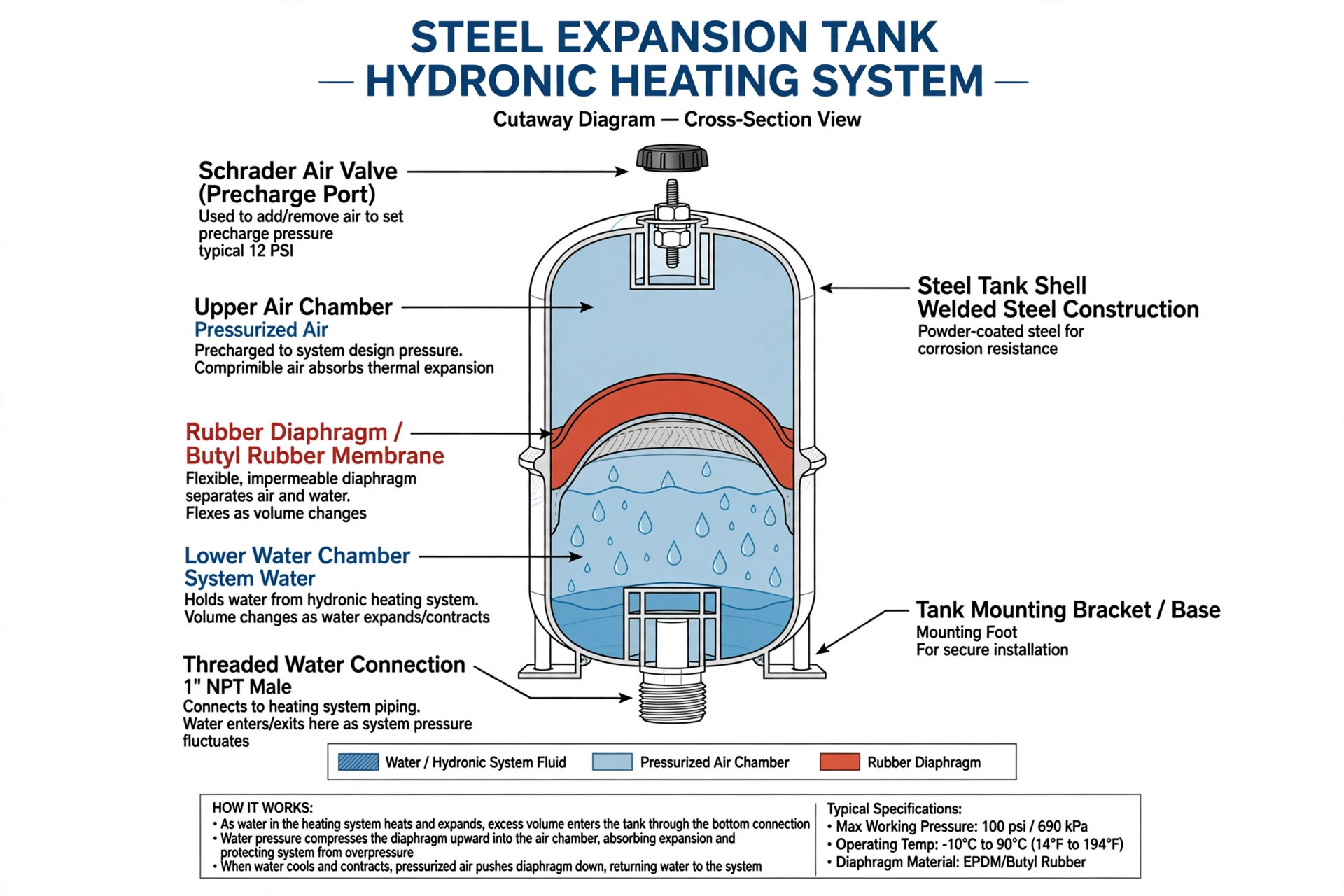
把膨胀水箱剖开看,结构其实很简单:一个焊接钢罐,中间一张橡胶隔膜,隔膜上面是空气、下面是水。罐子顶部有一个充气嘴(Schrader 气门嘴,和汽车轮胎上的一样),出厂时从这里充进 12 psi 左右的空气;罐子底部一个螺纹接口,接暖气系统的管道。锅炉冷态的时候,系统水压和罐子里的气压差不多,隔膜基本不动,水只占罐子底部一小部分;锅炉一烧、水一胀,多出来的水被压进罐子,隔膜被顶上去,空气被压缩、体积变小、压力升高——水多出来的那几升,等于被空气“让”出来的空间装下了。Cut an expansion tank open and the structure is simple: a welded steel tank, a rubber diaphragm across the middle, air above the diaphragm and water below it. On top of the tank is an air valve (a Schrader valve, the same kind as on a car tyre), through which the tank is factory-charged with about 12 psi of air; at the bottom is a threaded connection to the heating pipework. When the boiler is cold, system water pressure and the tank's air pressure are about equal, the diaphragm barely moves, and water occupies only a small part of the bottom of the tank. When the boiler fires and the water expands, the extra water is pushed into the tank, the diaphragm is pressed upward, and the air is compressed — smaller in volume, higher in pressure. The extra litres of water are held in the space the air has "given up."
这里面的物理规律是波义耳定律:温度不变时,气体的压力和体积成反比——空气体积被压到一半,压力就翻一倍。系统水温从 20°C 升到 80°C,水体积多出约 2.5%,罐子里的空气就被压缩相应的比例,系统压力从冷态的 12 psi 慢慢升到热态的 18–20 psi 左右,离安全阀 30 psi 的起跳压力还远得很。锅炉一停、水一凉,水体积缩回去,罐子里的压缩空气把水顶回系统,隔膜回到原位——整个过程没有阀门开关、没有电机转动,全靠空气能压缩、水不能压缩这一对性质。The physics here is Boyle's law: at constant temperature, a gas's pressure and volume are inversely proportional — compress the air to half its volume and its pressure doubles. As system water warms from 20 °C to 80 °C, its volume grows by about 2.5%, the air in the tank is compressed by the corresponding amount, and system pressure climbs gently from a cold 12 psi to a hot 18–20 psi or so — still far below the relief valve's 30 psi opening pressure. When the boiler stops and the water cools, its volume shrinks back, and the compressed air pushes the water out of the tank and back into the system, the diaphragm returning to its rest position. The whole cycle needs no valve opening, no motor turning — it runs entirely on one pair of properties: air can be compressed, water cannot.
隔膜的作用,是把空气和水彻底隔开:没有隔膜,罐子里的空气会慢慢溶进热水里、被水带走,罐子就变成一个装满水的铁罐,再也吞不下膨胀的水——老式的开式膨胀水箱就是这个毛病,空气跑了、水位掉了,系统要经常补水补气,现代的隔膜式罐子就是为了解决这个问题才出现的。罐子装在哪里也有讲究:装在循环泵吸入口附近、系统压力最稳定的地方,隔膜受力最均匀,寿命也最长。The diaphragm's job is to keep the air and the water completely apart: without it, the air in the tank would slowly dissolve into the hot water and be carried away, and the tank would become a plain iron tank full of water, unable to absorb any more expansion. That was exactly the fault of the old open expansion tanks — the air escaped, the water level dropped, and the system needed constant topping up of water and air. The modern diaphragm tank exists to solve that problem. Where the tank is mounted matters too: near the circulator's suction side, where system pressure is most stable, the diaphragm is loaded most evenly and lasts longest.
四、材料、磨损与性能曲线:从分子层面看膨胀水箱为什么会坏4. Materials, wear and performance curves: why an expansion tank fails, down to the molecular level
膨胀水箱泡在热水里、顶着压力几十年,磨损是从分子层面开始的。第一是隔膜老化:隔膜一般是丁基橡胶(butyl)或三元乙丙橡胶(EPDM),丁基橡胶气密性最好、空气分子最难穿过去,EPDM 耐高温更好。橡胶是长链高分子,热水和氧气会让分子链慢慢断裂、交联点失效,隔膜越用越硬、弹性越差,最后出现细裂纹——裂纹一出现,空气就漏进水里,罐子慢慢变成装满水的铁罐。第二是空气渗透:就算隔膜没有裂纹,氮气和氧气分子也会以极慢的速度穿过橡胶分子链之间的空隙,预充气压一年比一年低,罐子能吞的水一年比一年少——这就是为什么膨胀水箱要列入暖气系统的每年保养,师傅保养时会测预充气压、测系统压力曲线。An expansion tank sits in hot water under pressure for decades, and the wear starts at the molecular level. First, diaphragm ageing: the diaphragm is usually butyl rubber or EPDM. Butyl rubber seals gas best — air molecules have the hardest time passing through it — while EPDM handles high temperatures better. Rubber is made of long polymer chains, and hot water and oxygen slowly break those chains and destroy the cross-links, so the diaphragm grows stiffer and less elastic with age, and eventually develops fine cracks. Once a crack appears, air leaks into the water and the tank slowly becomes an iron tank full of water. Second, air permeation: even with no crack at all, nitrogen and oxygen molecules diffuse, very slowly, through the gaps between the rubber's polymer chains, so the precharge pressure falls a little every year and the tank can absorb a little less water every year. That is why the expansion tank belongs on the heating system's annual service list — during a service, the technician measures the precharge pressure and the system's pressure curve.
第三是钢壳腐蚀:罐体是碳钢焊接成型、表面喷塑,隔膜完好的时候钢壳根本不碰水;隔膜一裂,水直接接触钢壳内壁,水里的氧气和氯离子就开始电化学腐蚀——铁原子失去电子变成铁离子(Fe → Fe²⁺ + 2e⁻),再和氢氧根结合生成铁锈,罐底慢慢变薄。温哥华、大温地区的水质偏软、氯离子浓度不高,腐蚀比硬水区慢,但水里的溶解氧是绕不过去的:只要隔膜破了,钢壳腐蚀就开始计时。第四是焊缝疲劳:系统每天烧热冷凉,罐体每天胀缩一次,焊缝处应力集中,几十年下来金属疲劳会在焊缝根部攒出微裂纹——所以膨胀水箱的焊口质量和喷塑质量,比罐子大小本身还重要。Third, steel shell corrosion: the tank is welded carbon steel with a powder-coated surface, and while the diaphragm is intact the steel never touches water. Once the diaphragm cracks, water meets the inside of the steel shell directly, and the oxygen and chloride ions in the water start electrochemical corrosion — iron atoms lose electrons to become iron ions (Fe → Fe²⁺ + 2e⁻), which combine with hydroxide to form rust, and the bottom of the tank thins over time. Water in Vancouver and Greater Vancouver is fairly soft with low chloride, so corrosion is slower than in hard-water regions — but dissolved oxygen in the water cannot be avoided: once the diaphragm is breached, the steel shell's corrosion clock starts. Fourth, weld fatigue: the system heats and cools every day, the tank expands and contracts every day, stress concentrates at the welds, and over decades metal fatigue accumulates micro-cracks at the weld root. That is why the quality of an expansion tank's welds and coating matters even more than the size stamped on it.
性能曲线说的是另一回事:罐子的“接纳容积”(acceptance volume)——水热胀时罐子实际能吞下的水量——取决于预充气压和安全阀起跳压力这两个数。预充 12 psi、安全阀 30 psi 的罐子,接纳容积大约是罐子总容积的 40% 左右;预充气压越高,接纳容积越小。温哥华大温地区的大房子,地暖盘管几千尺、系统水量上百升,算下来常常要 7.6 加仑甚至更大的罐子,算错了,锅炉一烧热安全阀就泄水,系统天天补水、压力天天波动。这就是为什么膨胀水箱看着只是一个红色铁罐,配它的活却一点不便宜:算水量、算膨胀量、配罐子、定预充气压、还要每年保养,少了哪一步,锅炉和热水器的寿命都要打折。The performance curves tell another story: a tank's "acceptance volume" — how much water it can actually take in when the water expands — depends on two numbers, the precharge pressure and the relief valve's opening pressure. A tank precharged to 12 psi with a 30 psi relief valve has an acceptance volume of roughly 40% of its total volume; the higher the precharge, the smaller the acceptance volume. In a large Vancouver or Greater Vancouver house, with thousands of feet of radiant tubing and well over a hundred litres of system water, the calculation often calls for a 7.6-gallon tank or larger — get it wrong and the relief valve dumps water every time the boiler heats up, the system is topped up daily, and the pressure swings daily. That is why an expansion tank that looks like a plain red steel can is not cheap work to fit: calculating the water volume, the expansion, the tank size and the precharge, and servicing it every year — skip any one of those steps and the boiler and water heater pay for it in service life.
最后说一句中心思想:BC 家里冬天要恒温,最低 20 度,舒适是 24–25 度。地暖和暖气片最怕频繁停机再猛烧——停八小时、再猛烧八小时,锅炉和热水器都伤得更快,木架房子、水管、风管、消防管也跟着受罪。BC 天然气很便宜,一次维修保养的钱就抵一年的燃气费,恒温住着,才是对房子最好的保护。One last point, and it is the point that runs through everything on this site: a BC home stays at a constant temperature in winter — 20 °C at the minimum, 24–25 °C for comfort. Radiant floors and radiators hate being shut off and then fired hard — eight hours off and eight hours of full burn wears the boiler and water heater faster, and the wood-frame house, its pipes, ducts and sprinkler lines suffer with it. BC natural gas is cheap; one service visit costs about a year's worth of gas. Keeping the house at a steady temperature is the best protection a house can get.
漏水了?先关水,再打电话Leaking? Shut the Water Off, Then Call
爱家冷暖 24 小时紧急维修,水管漏水是日常活。打电话说清漏水位置和现象,师傅能先判断要不要马上上门,紧急情况优先处理。Ai Jia Nuan offers 24-hour emergency service — pipe leaks are everyday work. Call with the leak location and symptoms; the technician can judge whether an immediate visit is needed, with emergencies prioritised.
微信:PE-2009 · 更多服务见 WeChat: PE-2009 · More services at pe2009.com