
温哥华大温地区老房 Poly-B 水管换铜管:锅炉、热水器、地暖、暖气全都要跟着动,成本为什么这么高?Replacing Poly-B Pipes with Copper in an Older Vancouver Home: Why the Boiler, Water Heater, Radiant Floor and Radiators All Have to Move — and Why It Costs So Much
温哥华大温地区 1970 到 1990 年代建的房子,墙里很可能还跑着灰色的 Poly-B 水管。换管不是换几根管子:锅炉、热水器、地暖、暖气全都接在这套管子上面,动一根,全家都要动。Many homes built in Vancouver and Greater Vancouver between the 1970s and the 1990s still have grey Poly-B water pipes inside their walls. Replacing them is not a matter of swapping a few pipes: the boiler, the water heater, the radiant floor and the radiators are all connected to the same network — move one pipe, and the whole house moves with it.
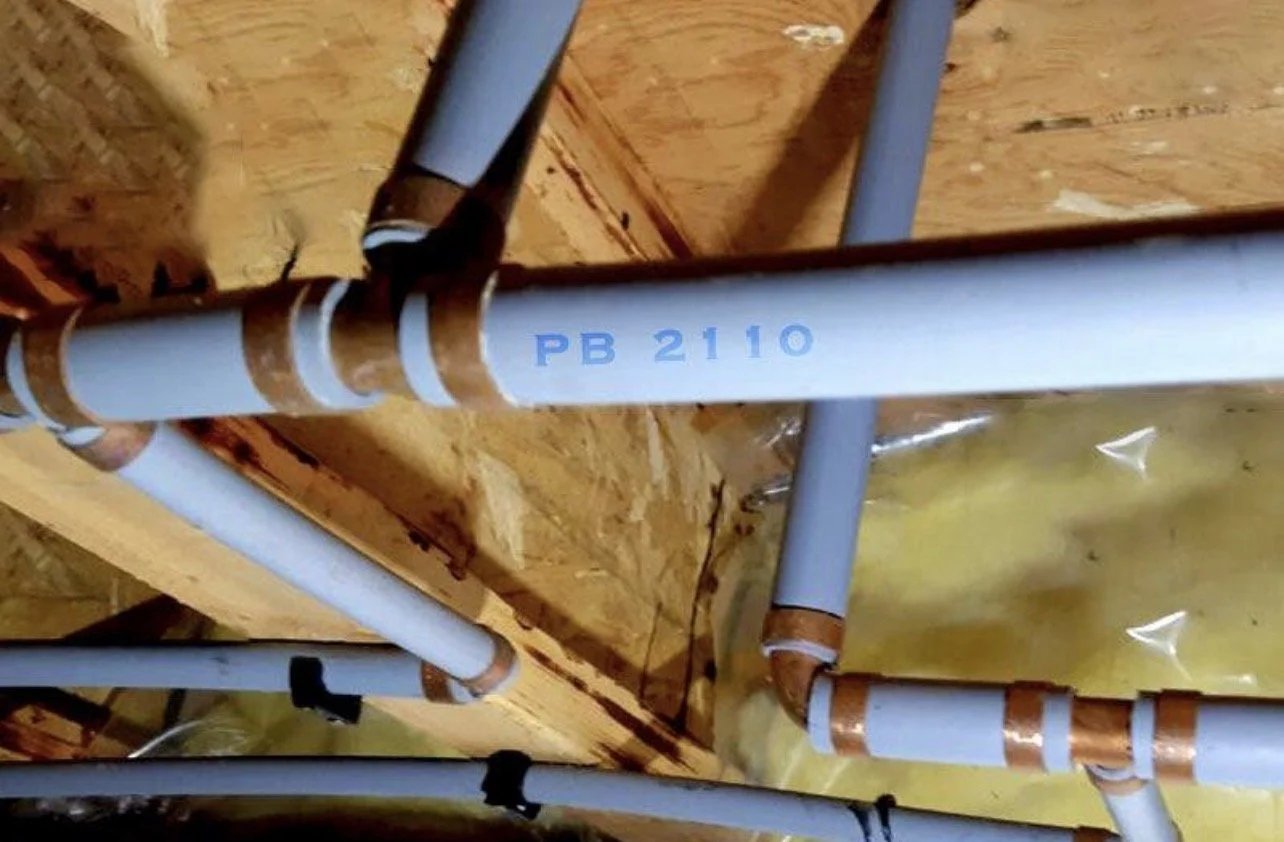
先说结论:Poly-B 的问题出在分子结构上,不在安装手艺上。它的分子链是直的、没有交联,水里的氯一啃就断,断点先从热水管和接头开始。所以这不是修修补补能解决的事,整屋换管是迟早的。而换管之所以贵,贵在它是一项系统工程——锅炉、热水器、地暖、暖气全都要跟着动。The conclusion first: the problem with Poly-B is in its molecular structure, not in how it was installed. Its molecular chains are straight, with no cross-links, and the chlorine in the water chews through them until they break — starting with the hot-water lines and the fittings. So this is not something a patch repair can fix; a whole-house replacement is only a matter of time. And the reason replacement is expensive is that it is a system-wide job — the boiler, the water heater, the radiant floor and the radiators all have to move with it.
一、Poly-B 是什么:温哥华老房墙里的灰管子1. What Is Poly-B? The Grey Pipe Inside the Walls of Older Vancouver Homes
Poly-B,全名聚丁烯(polybutylene),是 1970 年代到 1990 年代中期北美住宅大量使用的一种灰色塑料水管。大温地区 (Vancouver, Surrey, Burnaby, Richmond, UBC, Coquitlam, Delta, Maple Ridge, New Westminster, Langley, North Vancouver, Port Coquitlam, West Vancouver, and Port Moody) 那个年代建的独立屋、城市屋,十有八九墙里跑的就是它。它的接头是灰色塑料插接件(乙缩醛),外面再套一个铜压环压紧。Poly-B, short for polybutylene, is a grey plastic water pipe that was widely installed in North American homes from the 1970s to the mid-1990s. In Greater Vancouver, most detached houses and townhouses built in that era have it inside their walls. Its fittings are grey plastic insert fittings (acetal), squeezed tight with a copper crimp ring.
它当年流行是有原因的:比铜管便宜得多,管子本身是软的,可以弯着走,安装快,正好赶上温哥华大温地区那一波建房高峰。但它在房子里干的活可不轻:冷热水管是它,锅炉的供回水是它,热水器的进出水是它,有些房子的地暖分水器、暖气片支路也是它。一套 Poly-B 管网,就是整栋房子的水路和暖气水路。It was popular for a reason: far cheaper than copper, flexible enough to bend around corners, and fast to install — right in the middle of the Greater Vancouver housing boom. But the work it does in a house is heavy: the hot and cold water lines are Poly-B, the boiler's supply and return are Poly-B, the water heater's inlet and outlet are Poly-B, and in some homes the radiant floor manifold and the radiator branches are Poly-B too. One Poly-B network is the whole house's water and heating-water system.
1990 年代中期以后,Poly-B 在北美停产,官司赔了一大笔。但温哥华大温地区已经建好的房子,管子还留在墙里。保险公司现在一听说房子里有 Poly-B,有的加价,有的直接不保——这也是很多房主最后决定整屋换管的导火索。Production stopped in North America in the mid-1990s after major class-action settlements. But in the homes already built across Greater Vancouver, the pipes are still in the walls. Insurers now ask about Poly-B specifically — some charge more, some will not insure the home at all — and that is often what finally pushes a homeowner to replace the whole system.
二、换掉 Poly-B 不只是保险的要求:买卖房子时最关键的议价点2. Replacing Poly-B Is Not Just About Insurance: It Is the Sharpest Bargaining Chip in a House Sale
保险只是第一层。很多房主决定换管,真正的原因在买卖房子的时候才看出来:Poly-B 是谈价时最硬的一张牌。买家一听说房子里是 Poly-B,砍价就有了实打实的理由——整屋换管是迟早要花的钱,买家会直接从报价里扣掉这笔账,有时候成交价能差到 10 万加币。更干脆的买家连谈都不谈:验房报告里一出现 Poly-B,就直接把这套房子从名单里划掉。Insurance is only the first layer. For many homeowners, the real reason to replace the pipes only becomes clear when the house is bought or sold: Poly-B is the hardest bargaining chip at the negotiating table. The moment a buyer hears the house has Poly-B, they have a concrete reason to cut the price — a whole-house re-pipe is money that will have to be spent sooner or later, and the buyer simply deducts it from the offer. Sometimes the gap in the sale price reaches CAD 100,000. Blunter buyers do not negotiate at all: once Poly-B shows up in the inspection report, the house comes straight off their list.
买卖还是其次,住在里面才是最实在的。Poly-B 的管子藏在墙的夹层里,漏水不是滴在眼前,是顺着木架往下淌,等楼下天花板出现水渍,上面已经漏了好一阵子。夹层里一根水管破了,一小时内就能把家全淹了——地板、石膏板、家具、电器,一层一层泡过去。这种风险,住着的人心里最清楚。The sale is secondary; living in the house is what matters most. Poly-B pipes hide inside the wall cavities, so a leak does not drip where you can see it — it runs down inside the wood framing, and by the time a stain appears on the ceiling below, it has been leaking for a while. One burst pipe inside a wall cavity can flood the whole house within an hour — floors, drywall, furniture, appliances, one after another. Nobody knows that risk better than the person living there.
所以在温哥华大温地区,换管从来不只是一项“修水管”的工程,它是房子保值的一部分。保险、成交价、住得安心,三件事都系在同一套管子上。So in Vancouver and Greater Vancouver, replacing the pipes is never just a plumbing job — it is part of protecting the value of the house. Insurance, the sale price and peace of mind at home all hang on the same set of pipes.
三、三种材料的分子结构:Poly-B、铜管、PEX 管为什么命运不同3. The Molecular Structure of Three Materials: Why Poly-B, Copper and PEX Have Such Different Fates
三种管子,三种完全不同的分子世界。看懂这张图,就看懂了为什么 Poly-B 注定会坏,而铜管和 PEX 管不会走它的老路。Three pipes, three completely different molecular worlds. Understand this diagram, and you understand why Poly-B was bound to fail while copper and PEX are not heading down the same road.
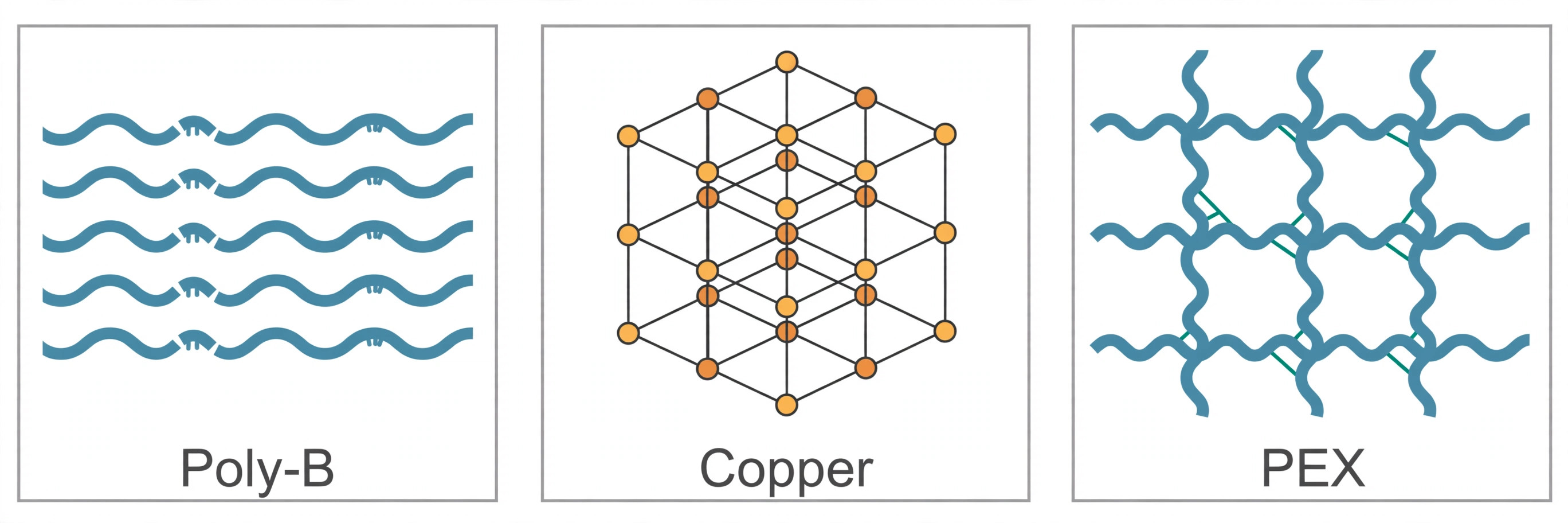
Poly-B:直线链,没有交联。它的分子是一条一条长链,化学式可以写成 —[CH₂—CH(CH₂CH₃)]—,链与链之间只靠微弱的分子间作用力拉着,没有任何化学键把链连起来。这样的结构最怕氧化:温哥华的自来水里加氯消毒,水里的次氯酸会攻击分子链上的叔碳,把长链一切两段,这叫断链。断链多了,管壁上先出现肉眼看不见的微裂纹,裂纹再慢慢长大。热水加速这个过程,所以 Poly-B 总是先坏在热水管和锅炉、热水器附近的接头上。Poly-B: straight chains, no cross-links. Its molecules are long chains, written as —[CH₂—CH(CH₂CH₃)]—, held to each other only by weak intermolecular forces, with no chemical bonds tying the chains together. That structure is most vulnerable to oxidation: the chlorine added to disinfect Vancouver's tap water forms hypochlorous acid, which attacks the tertiary carbon on the chain and cuts a long chain into two — chain scission. As scission accumulates, invisible micro-cracks appear in the pipe wall and slowly grow. Hot water speeds the process up, which is why Poly-B always fails first on hot-water lines and on the fittings near the boiler and the water heater.
铜管:面心立方晶格,金属键。铜原子的排列是面心立方晶格,每个铜原子周围有 12 个邻居,靠金属键连成一片,自由电子在晶格里流动。铜没有分子链,也就不存在断链这回事。铜的腐蚀是表面电化学过程,在正常水质里进行得非常慢;铜的熔点是 1085°C,热水器的出水温度对它来说根本不算什么。铜管的接头要烧焊,焊料把两个铜件熔成一体,接头强度不比管身差。Copper: a face-centred cubic lattice, metallic bonds. Copper atoms sit in a face-centred cubic lattice, each atom surrounded by 12 neighbours, joined by metallic bonds with free electrons moving through the lattice. There is no molecular chain, so there is nothing to cut. Copper corrodes only by a slow surface electrochemical process in normal water, and its melting point is 1,085°C — the outlet temperature of a water heater is nothing to it. Copper joints are soldered, and the solder fuses the two pieces into one, so the joint is no weaker than the pipe itself.
PEX 管:交联成网的聚乙烯链。PEX 的原料和普通聚乙烯一样是 —[CH₂—CH₂]—,但经过交联处理(过氧化物交联是 PEX-a,硅烷交联是 PEX-b,电子束交联是 PEX-c),链与链之间长出了化学键,一整根管子变成一张三维网。交联网有两个好处:一是抗蠕变,管子在热水和压力下不会慢慢被拉长变形;二是形状记忆,扩口之后会自己缩紧抱住接头。PEX 的耐氯性比 Poly-B 好得多,但它怕紫外线,见不得阳光,而且按温哥华的规矩,明管、锅炉房的走管只用铜管,不用 PEX 管,PEX 只适合走墙内暗埋。PEX: polyethylene chains cross-linked into a network. PEX starts from the same —[CH₂—CH₂]— chains as ordinary polyethylene, but cross-linking (peroxide for PEX-a, silane for PEX-b, electron beam for PEX-c) grows chemical bonds between the chains, turning the whole pipe into a three-dimensional network. The network brings two advantages: resistance to creep, so the pipe does not slowly stretch out of shape under hot water and pressure, and shape memory, so an expanded end shrinks back and grips the fitting. PEX resists chlorine far better than Poly-B, but it has no UV resistance — it must never see sunlight — and under Vancouver practice, exposed runs and boiler-room piping are copper only, never PEX; PEX belongs inside the walls.
- 分子结构:Poly-B 是无交联直线链;铜是金属晶格;PEX 是交联网。Molecular structure: Poly-B is uncross-linked straight chains; copper is a metallic lattice; PEX is a cross-linked network.
- 怕什么:Poly-B 怕水里的氯;铜怕酸性水;PEX 怕紫外线。What each fears: Poly-B fears chlorine in the water; copper fears acidic water; PEX fears ultraviolet light.
- 接头:Poly-B 是塑料插接件加铜压环;铜管是烧焊接头;PEX 是扩口或压接。Joints: Poly-B uses plastic insert fittings with copper crimp rings; copper uses soldered joints; PEX uses expansion or crimp fittings.
- 热水工况:Poly-B 在热水里老化最快;铜管和 PEX 管按北美标准都额定为长期热水工况,PEX 的热水额定在 82°C、100 psi。Hot-water service: Poly-B ages fastest in hot water; copper and PEX are both rated to North American standards for long-term hot-water service, with PEX rated at 82°C and 100 psi.
一句话:Poly-B 的坏,是分子结构注定的。它的链是直的、散的,氯一啃就断;铜的晶格和 PEX 的交联网,从结构上就不给氯这个机会。这也是为什么换管的时候,师傅不会只换坏掉的那一段——整套管网的分子结构是一样的,坏是迟早遍及全屋的。In one sentence: Poly-B's failure is written into its molecular structure. Its chains are straight and loose, and chlorine cuts them; the copper lattice and the PEX cross-linked network give chlorine no such opening by their very structure. That is also why a tradesperson does not replace only the failed section — the whole network shares the same molecular structure, and failure will reach the rest of the house sooner or later.
四、换管工程图:整屋换管到底要动多少地方4. The Replacement Drawing: How Much of the House a Whole-House Re-Pipe Actually Touches
看这张剖面图就明白:换管不是换一根管子,是把一栋木架房子的水路系统整个换掉。地下室的锅炉、热水器、分水器是起点,两根立管穿过两层楼,横管再分到厨房和每个卫生间。图里红色虚线框出来的地方,都是要打开的墙和天花。This cross-section tells the story: a re-pipe is not one pipe, it is the replacement of a wood-frame house's entire water system. The boiler, the water heater and the manifold in the basement are the starting point, two risers run through both floors, and horizontal runs branch off to the kitchen and every bathroom. Everywhere the drawing marks with a red dashed box is a wall or ceiling that has to be opened.
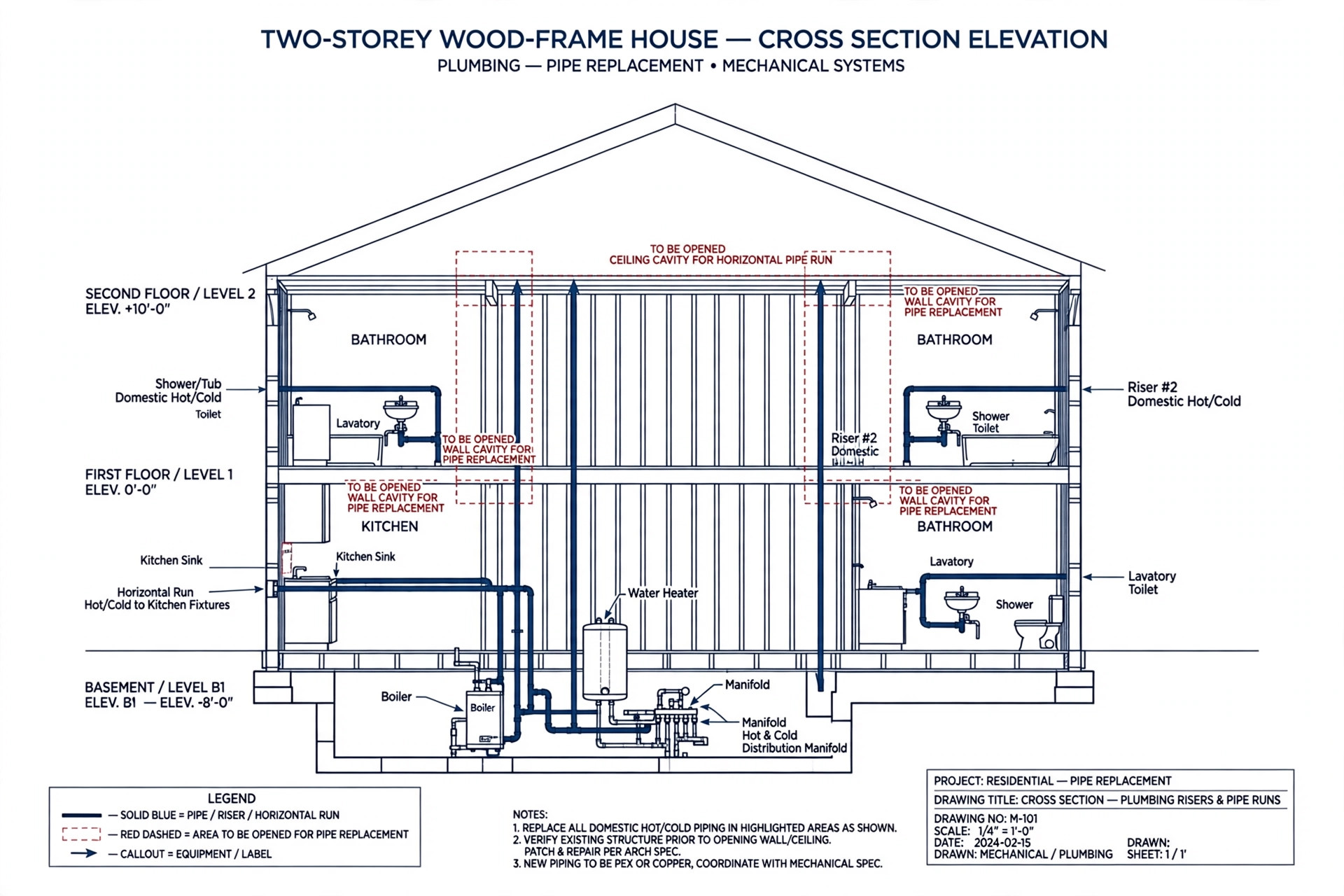
旧的 Poly-B 管是抽不出来的——它穿在木架的墙骨和楼板托梁之间,转弯抹角,当年钉上去的时候就没打算再取出来。换管的做法是把旧管留在墙里作废,沿着它再走一套新管。新管要穿木架、开新孔、做防火封堵,走到锅炉、热水器、地暖分水器、暖气片支路,每一处都要重新接。The old Poly-B cannot be pulled out — it threads through the wood framing's studs and floor joists, bent around corners, and was never meant to come back out. The replacement method is to abandon the old pipe in the wall and run a new system alongside it. The new pipe has to pass through the framing, need new holes drilled, fire-stopping installed, and every connection remade — to the boiler, the water heater, the radiant floor manifold and the radiator branches.
这里有个容易误会的地方:地暖本身的盘管通常不动。温哥华大温地区的地暖盘管埋在自流平水泥下面,动它等于把房子重做一遍。换管动的是分水器以上的供回水管——从锅炉出来、到分水器、再回锅炉的那一段。暖气片也一样:暖气片本体不动,动的是墙里的支路和阀门。锅炉和热水器更不用说:进出水全断开,换完管再重接、注水、排气、重新调试。One point is easy to misunderstand: the radiant floor loops themselves usually stay put. In Greater Vancouver, hydronic floor loops are buried under self-levelling cement — touching them means redoing the house. What gets replaced is everything above the manifold: the supply and return from the boiler to the manifold and back. Radiators are the same: the radiator stays, the branch lines and valves in the wall are replaced. And the boiler and the water heater, of course, are disconnected entirely, then reconnected, refilled, bled and recommissioned once the new pipe is in.
五、成本为什么这么高:贵在看不见的地方5. Why It Costs So Much: The Money Is in the Parts You Cannot See
管子本身的材料钱,在整单里只占一小部分。换管的成本高,是因为它同时是四项工程:水管工程、木工泥水工程、油漆工程和暖气调试工程。拆开看就明白了。The pipe material itself is only a small part of the bill. A re-pipe is expensive because it is four jobs at once: plumbing, carpentry and drywall, painting, and heating recommissioning. Break it down and the cost makes sense.
先给一个大致的数:温哥华大温地区一栋独立屋整屋换掉 Poly-B,费用大致在 1 万到 3 万加币之间,具体看房子大小、用水点多少、锅炉、热水器、地暖、暖气要重接几处。地暖管道不算在内——地暖盘管埋在厚厚的水泥下面,更换成本和难度极高,不在整屋换管的范围里。换完管还有补墙恢复:石膏板、打磨、上漆,费用 1 万加币左右,视房屋的破坏程度和豪华程度上下浮动。First, a rough number: replacing all the Poly-B in a detached house in Vancouver and Greater Vancouver generally costs between CAD 10,000 and CAD 30,000, depending on the size of the house, the number of fixtures, and how many reconnections the boiler, water heater, radiant floor and radiators need. The radiant floor loops are not included — they are buried under thick cement, and replacing them is extremely costly and difficult, so they fall outside a whole-house re-pipe. After the pipes comes wall restoration — drywall, sanding and painting — around CAD 10,000, varying with how much was opened up and how high-end the finishes are.
- 开墙、修墙:每一处用水点都要开墙开顶,换完管还要把石膏板补回去、打磨、上漆。泥水和油漆的活,比水管本身的活还多。Opening and restoring walls: every fixture location needs a wall or ceiling opened, and after the pipe is in, the drywall has to be patched, sanded and painted. The drywall and paint work is more than the plumbing itself.
- 停水、停暖:锅炉、热水器要停机、排空,换完管再注水、排气、重新调试。换管本身就要两周,冬天施工还要防冻,工期要和住户的生活排开。Shutting down water and heat: the boiler and the water heater have to be drained and shut down, then refilled, bled and recommissioned. The pipe replacement alone takes about two weeks, and in winter the work has to be sequenced around freeze protection, so the schedule has to be fitted around the household's life.
- 铜管烧焊:明管和锅炉房走铜管,铜管接头要烧焊,现场动火,防火措施不能少,木架房子里动火还要两个人配合,一个烧焊一个看着。这不是一个人一把扳手能干完的活。Soldering copper: exposed runs and the boiler room are copper, and copper joints are soldered — open flame on site, fire precautions mandatory, and in a wood-frame house the work takes two people, one soldering and one watching. This is not a one-person, one-wrench job.
- 许可证和验收:按温哥华市府的规定,安装、改动或升级水管系统任何一部分都要办水管许可证,整屋换管属于改动水管系统,许可证和完工验收缺一不可。按市府 2026 年收费表,改动水管(不涉及洁具)每 30 米或不足 30 米收 $415,超出第一个 30 米的部分每 30 米再收 $115;验收不合格或工程没做完就要复检,每次复检 $282。修阀门水龙头、原位换洁具、通堵、补漏这四样才不用许可证——整屋换管不在豁免里。Permits and inspection: under City of Vancouver rules, installing, changing or upgrading any part of a plumbing system requires a plumbing permit, and a whole-house re-pipe counts as an alteration of the plumbing system — the permit and the final inspection are both mandatory. Under the City's 2026 fee schedule, altering plumbing (no fixtures involved) costs $415 for each 30 metres of piping or part thereof, plus $115 for each additional 30 metres beyond the first 30; a reinspection made necessary by faulty or incomplete work costs $282 each time. Only repairing or replacing valves and faucets, replacing fixtures in the same location, clearing stoppages and repairing leaks are exempt — a whole-house re-pipe is not.
- 老房子的额外项:1990 年前的房子,开墙之前可能要先做石棉检测——石膏板接缝、保温材料里都可能有石棉,查出来阳性就要请专业公司处理,这笔费用和工期都要另算。Extra items in older homes: in a pre-1990 house, asbestos testing may be needed before any wall is opened — drywall joint compound and insulation can contain asbestos, and a positive result means a specialist abatement crew, with its own cost and schedule.
- 工种协调和工期:水管、泥水、油漆、暖气调试,几个工种排队进场,互相等。光是换管子本身,从砸墙拆旧到装上新管,就要差不多两周——也不是天天连续做。后面补墙、等干、油漆、暖气调试,全套下来起码一个月,特别是冬天,石膏板干得好慢。如果没有一个月的时间,就很赶,特别赶,有些东西就做不好。Coordinating trades — and the schedule: plumber, drywaller, painter and heating technician have to be sequenced one after another, each waiting on the last. The pipe replacement alone, from smashing open walls and taking out the old pipe to installing the new, takes about two weeks — and the work is not continuous day after day. Then comes patching the drywall, waiting for it to dry, painting and recommissioning the heating, and the whole job takes at least a month. Drying is especially slow in winter. Without a full month, the job is rushed — very rushed — and some things do not get done properly.
三张施工实拍,看懂换管为什么要开墙、开天花板、挖地面:Three site photos that show why a re-pipe means opening walls, ceilings and floors:
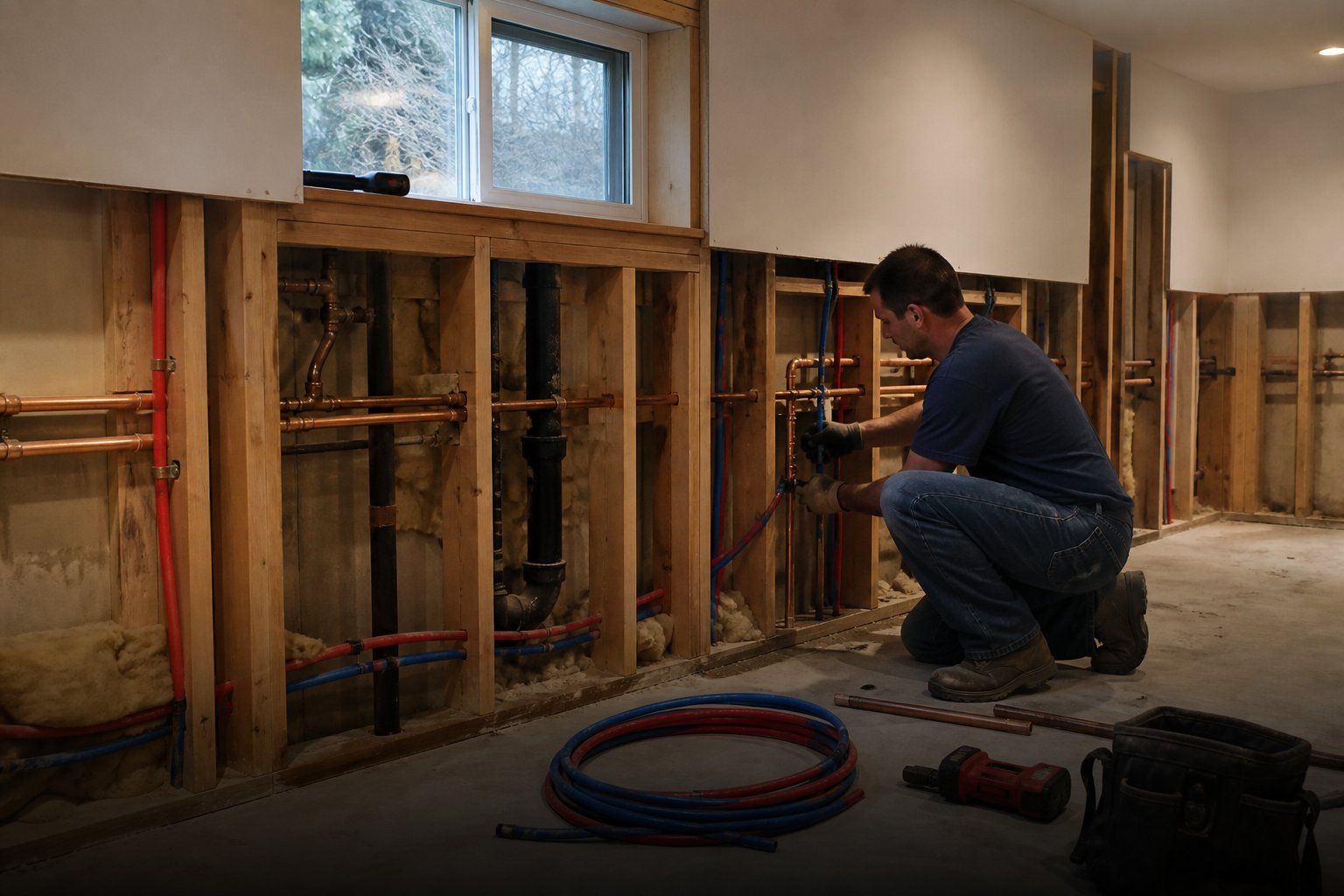
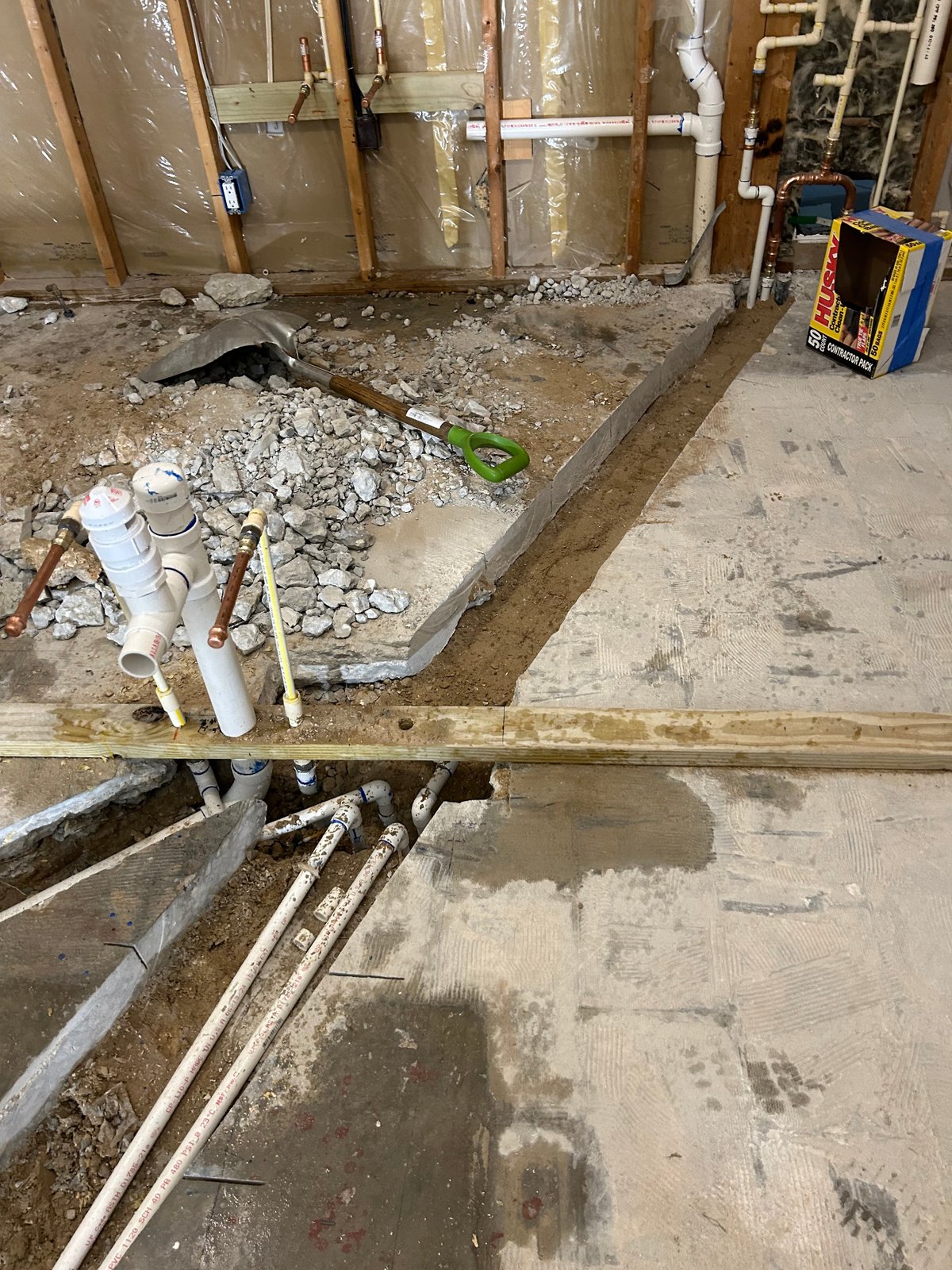
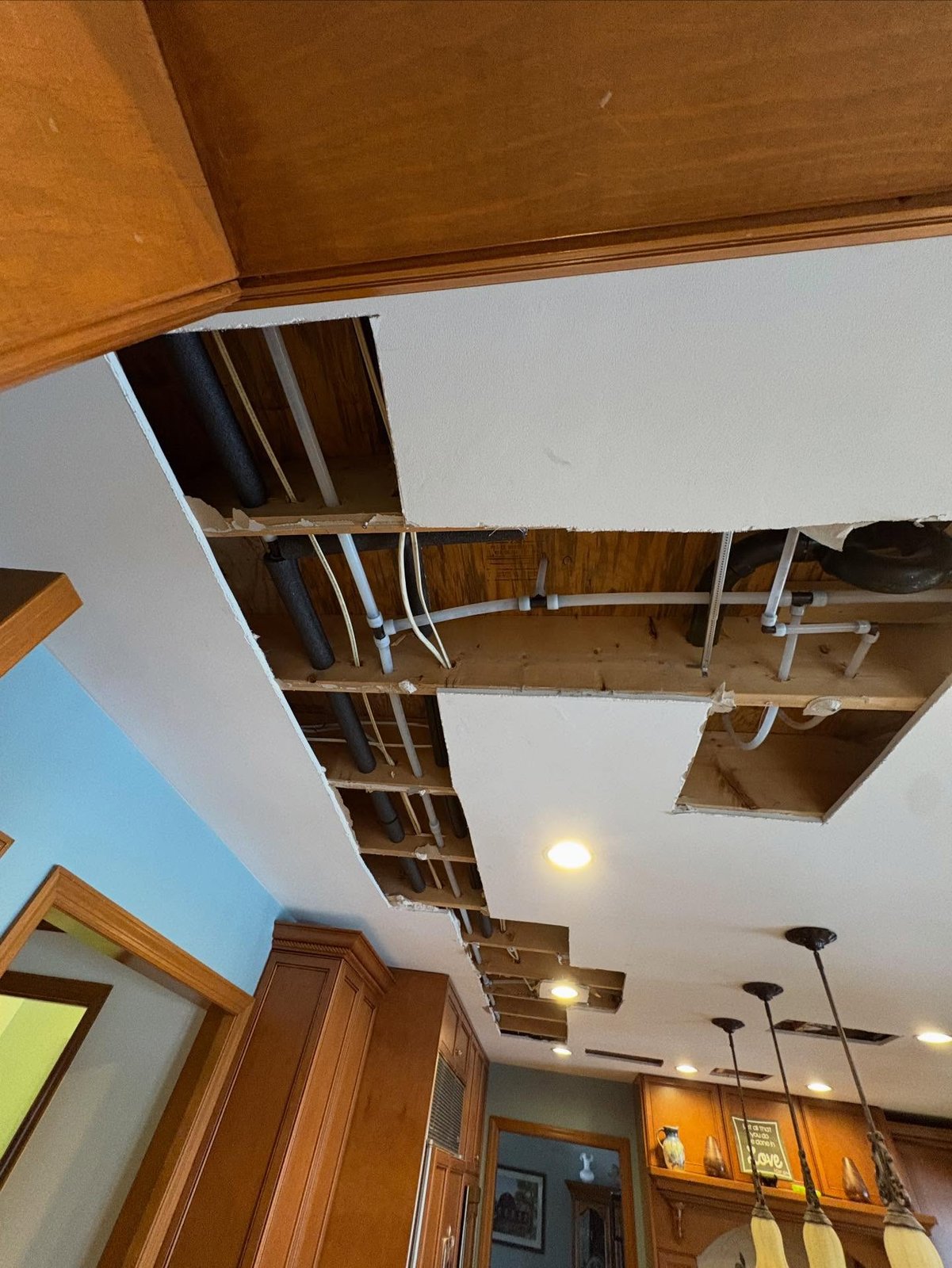
所以换管的账不能按“几根管子多少钱”来算,要按“多少处开墙、多少个工种、几周工期、锅炉热水器地暖暖气多少处重接”来算。材料是小头,打开、恢复、协调、重新调试才是大头。工程越复杂、牵涉的系统越多,收费就越高——这正是换管这项工作的本来面目。So the bill for a re-pipe cannot be counted in metres of pipe. It has to be counted in how many walls are opened, how many trades are involved, how many weeks the job runs, and how many reconnections the boiler, water heater, radiant floor and radiators need. The material is the small part; opening, restoring, coordinating and recommissioning is the large part. The more complex the job and the more systems it touches, the higher the price — that is simply what this work is.
六、已经买了带 Poly-B 的房子怎么办6. What If You Have Already Bought a House with Poly-B?
有条件的,在搬进去之前就全部换掉。房子空着,师傅开墙、换管、补墙都不用顾忌家具和生活,工期最短,对生活的打扰最小。这是温哥华大温地区很多买家收房后的第一件事。If you can, replace it all before you move in. With the house empty, the crew can open walls, run pipe and patch drywall without working around furniture and daily life — the shortest schedule and the least disruption. It is the first thing many buyers in Vancouver and Greater Vancouver do after taking possession.
没条件马上全换的,也别拖着不管。搬进去之后,至少请专业的 plumbing contractor 上门,把全屋的 Poly-B 系统检查一遍:哪些管段老化最厉害、接头是什么状态、锅炉、热水器、地暖、暖气各处怎么接,再出一份定制方案。拿着方案,心里才有底:先换哪一段、缓换哪一段、预算怎么排。检查和方案是师傅的事,房主的任务是找对公司,别自己动手。If a full replacement right away is not possible, do not just leave it. After moving in, at least have a professional plumbing contractor come and inspect the whole Poly-B system: which runs are most deteriorated, what condition the fittings are in, and how the boiler, water heater, radiant floor and radiators are connected — then put together a custom plan. With that plan in hand, you know what you are dealing with: which section goes first, which can wait, and how the budget lines up. The inspection and the plan are the tradesperson's job; the homeowner's job is to hire the right company and leave the work to them.
结尾:换管是系统工程,不是换管子Closing: A Re-Pipe Is a Systems Job, Not a Pipe Swap
回到开头那句话:Poly-B 的问题写在分子结构里,整屋换是迟早的事。换的时候别只盯着管子本身——锅炉、热水器、地暖、暖气是一个系统,要一起规划、一起重接、一起调试。温哥华大温地区木架房子的规矩是:家里恒温,任何时间最低 20 度,舒适是 24–25 度,恒温保护木架、水管、风管、消防管;换管期间停暖要安排好,停八小时猛烧八小时伤设备、坏得更快。Back to the opening point: the Poly-B problem is written into its molecular structure, and a whole-house replacement is only a matter of time. When it happens, do not fixate on the pipe alone — the boiler, the water heater, the radiant floor and the radiators are one system, to be planned, reconnected and recommissioned together. The rule for a wood-frame house in Greater Vancouver is constant temperature: never below 20°C at any time, 24–25°C for comfort, protecting the wood frame, the water lines, the air ducts and the fire pipes; schedule any heating shutdown during the re-pipe carefully, because stopping for eight hours and then firing hard for eight hours wears equipment out faster.
换管是持证水管师傅和燃气持证师傅配合干的活,锅炉那部分必须有燃气执照才能动。房主该做的是找对公司、看清方案、留好工期,剩下的交给师傅。A re-pipe is work for a licensed plumber working alongside a licensed gas fitter — the boiler side legally requires a gas licence. The homeowner's part is to pick the right company, understand the plan and allow the time it takes, and leave the rest to the tradespeople.
漏水了?先关水,再打电话Leaking? Shut the Water Off, Then Call
爱家冷暖 24 小时紧急维修,水管漏水是日常活。打电话说清漏水位置和现象,师傅能先判断要不要马上上门,紧急情况优先处理。Ai Jia Nuan offers 24-hour emergency service — pipe leaks are everyday work. Call with the leak location and symptoms; the technician can judge whether an immediate visit is needed, with emergencies prioritised.
微信:PE-2009 · 更多服务见 WeChat: PE-2009 · More services at pe2009.com